What Is Cedarwood Oil? Cedars, Junipers and Names
Here is a surprise for anyone who thinks of cedarwood as one tree's oil: the word "cedar" has been given to trees from several botanical families, and each one gives an oil with its own character. Some of those trees are true cedars. Others are junipers that early settlers called cedar because the wood smelled right. We sell oils from both, and the difference is a big part of the fun.

Cedarwood Essential Oil
Our own Cedarwood Essential Oil, in sizes from 0.5 oz to bulk.
From $9.99
Shop Now →A trade name, not a species
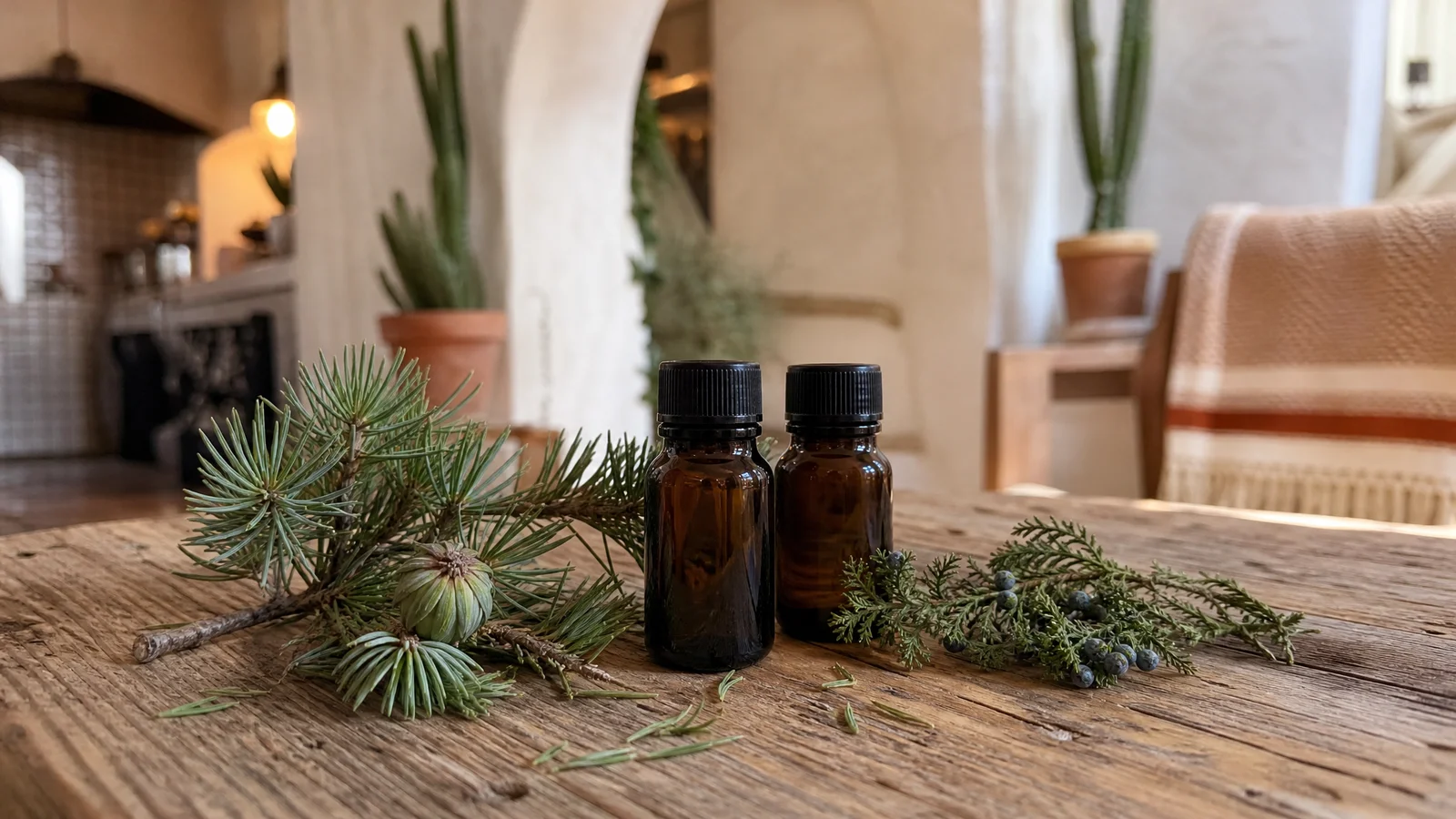
A 2026 review of cedarwood oils describes them as typically produced by steam-distilling the wood of junipers, cypresses or true cedars. Ten different genera of trees are commonly called cedar. The two groups we work with are the true cedars, in the genus Cedrus, which belongs to the pine family, and the junipers, in the genus Juniperus, which belongs to the cypress family. Each of our four oils is steam-distilled from wood.
| Our oil | The tree | Where the tree grows naturally |
|---|---|---|
| Atlas | Cedrus atlantica, a true cedar | The Rif and Atlas Mountains of North Africa |
| Himalayan | Cedrus deodara, a true cedar | The western Himalayas |
| Virginian | Juniperus virginiana, a juniper | The eastern United States |
| Texas | A juniper, listed by us as Juniperus mexicana | Central Texas, in the review's account of Texas cedar |
The last column describes the trees, not our bottles; the ranges come from the review. Our product pages say plainly which of the four are cedars and which are junipers.
Why they smell the way they do
Woody scents come mostly from sesquiterpenoids, large aromatic molecules that evaporate slowly. That slow evaporation is why cedarwood works as a base note and lingers in a blend long after brighter oils have faded. The true cedars are dominated by himachalenes: in the review's analysis of commercial oils, beta-himachalene averaged about 40 percent in 48 Atlas oils and about 35 percent in 43 Himalayan oils, with the Himalayan oils containing more of a group called atlantones. The Virginian juniper tells a different story, led by alpha-cedrene (about 32 percent in 56 oils), with cis-thujopsene, cedrol and widdrol behind it.
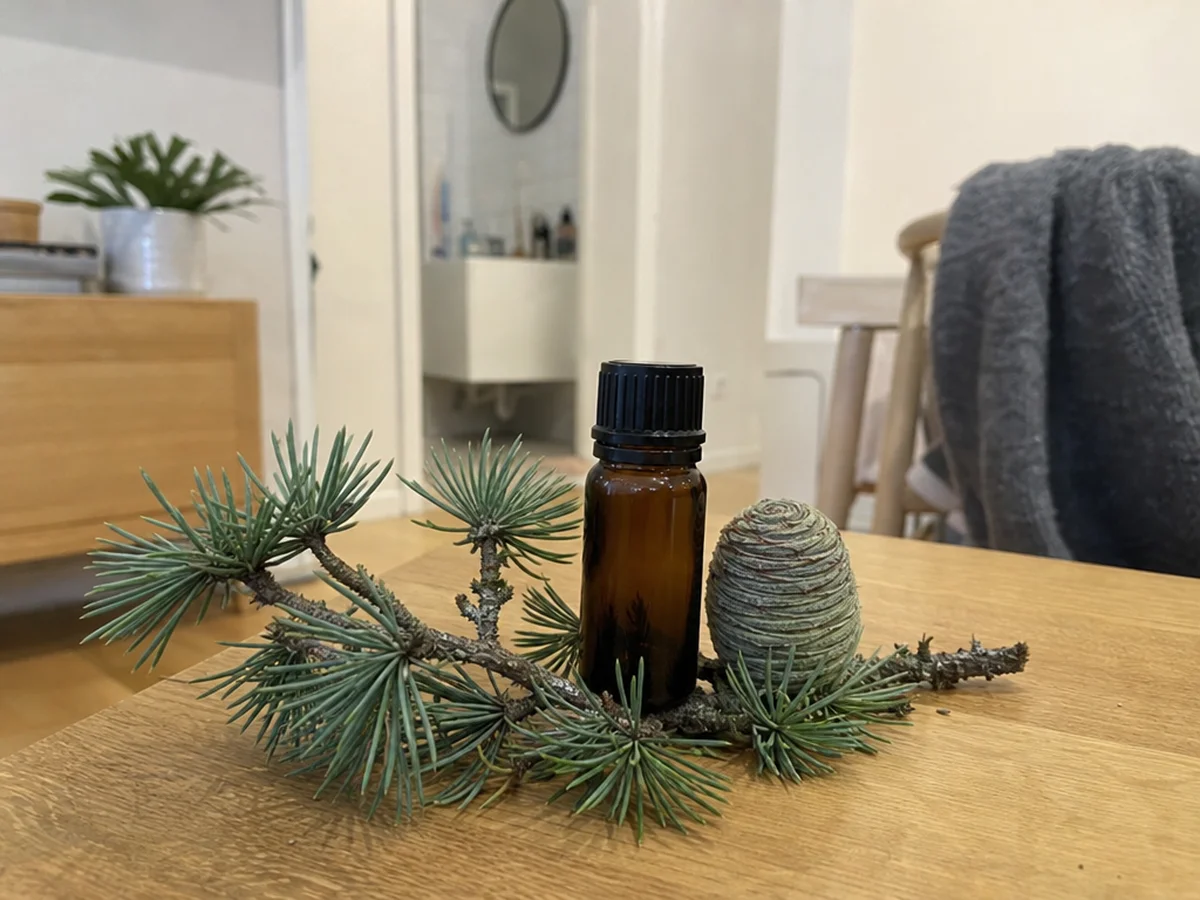
You do not need the chemistry to enjoy the result. You can smell it. We describe our Atlas oil as dry, woody and warmly sweet with a balsamic depth, and the Himalayan as warm, sweet and softly resinous. The Virginian is the classic pencil-shaving cedar of closet drawers and cedar chests, and the Texas sits comfortably between the Virginian and the Himalayan. These are general literature figures for commercial oils, not measurements of ours; the certificate of analysis we publish covers one Atlas batch and lists its density and refractive index. If you want a GC-MS report for a lot, ask us in writing through our contact page.
What you will notice when you open a bottle
Unscrew the cap and breathe in gently from a little distance, not straight into the bottle. The first impression of cedarwood is usually dry and woody, and it may remind you of a pencil, a cedar chest or a sunny plank. Depending on which tree it came from, you might notice sharpness, sweetness or a resinous softness. Then dab a drop on a paper strip and come back to it in ten minutes. Cedarwood is a base note, so the scent stays and deepens while lighter smells fade. That slow unfolding is a lot of the pleasure.
Not every cedar-named oil is cedarwood
Cedar leaf oil, from Thuja trees, is a different material containing thujone, and a 2025 review notes that it is sometimes mislabelled as cedarwood and kept out of the cedarwood group on safety grounds. We do not sell it. Our leaf oil comparison explains how the names got tangled.
What people use it for
Mostly its scent. Perfumers lean on it as a base, makers add it to soap and candles, and many people simply like it in a diffuser or a linen spray. Our uses tour and the perfumery article explore this. We sell cedarwood as an aroma and cosmetic material and make no remedy claims for it.
A small tasting routine
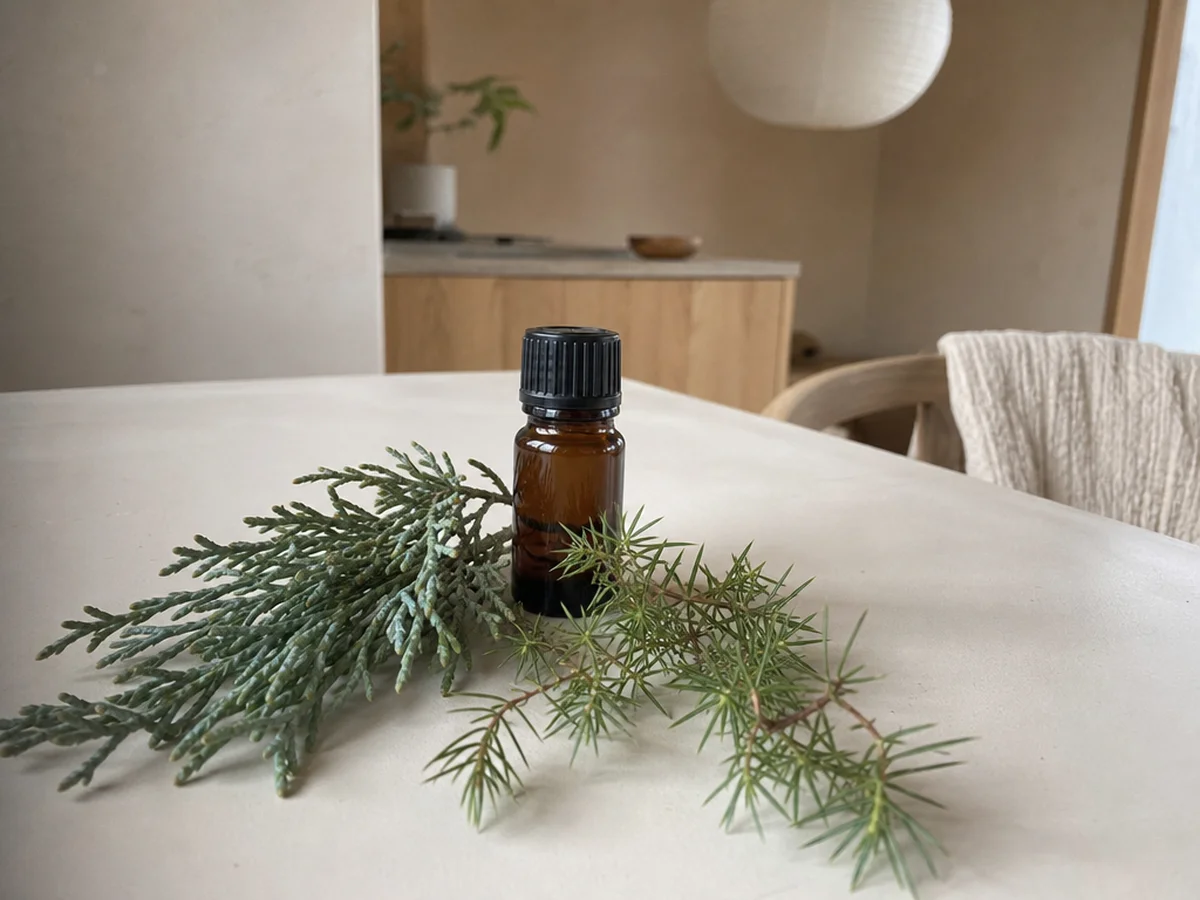
Treat your first bottle the way you might treat a new tea. Smell it on a clean strip, wait, and smell it again later. Notice whether it feels sharp, sweet or soft, and whether it reminds you of anything: a pencil box, a cedar closet, a warm shelf in a sunny room. Jot down a few words. Over time, those notes become your own reference for how each cedarwood behaves.
Choosing where to begin
If you are new to cedarwood, our suggestion is to start with the scent you picture. If you imagine a closet drawer, begin with the Virginian. If you picture something warmer and softer, the Himalayan is a good first try. The Atlas is dry and sweet at once, and the Texas sits in between. There is no wrong starting point, and many people end up keeping two or three on the shelf because each one does a different job.

Handling in brief
Our oils arrive neat, so they are for external use only. We recommend diluting to 0.5 to 2 percent in a carrier oil before it touches skin, patch testing first, and keeping it away from eyes, children and pets. Tisserand's general ranges for essential oils are lower for faces and sensitive skin, so we would begin at the low end. A 13-week study of Virginia cedarwood oil on rodent skin found changes at the application site at higher concentrations, which is another reason for restraint. Our safety overview is the place to go for pets, children and pregnancy.
For a side-by-side look at all four, read the family guide, or go deeper into the compounds in cedrol and atlantones.
One name, several trees, and a lot of woody character to explore.
Cedarwood Essential Oil
Cedarwood Essential Oil from our own shop, in sizes from 0.5 oz to bulk.
From $9.99
Shop Now →Sources & Further Reading
- Setzer WN, Satyal P. Cedarwood Oils: The Wood Essential Oil Compositions from Trees Known as "Cedar". Plants (Basel), 2026.
- Goncalves S. Cedarwood essential oil (Cedrus spp.): a forgotten pharmacological resource with emerging therapeutic potential. Exploration of Drug Science, 2025.
- Catlin NR et al. Dose-response assessment of the dermal toxicity of Virginia cedarwood oil in F344/N rats and B6C3F1/N mice. Food and Chemical Toxicology, 2016.
- Tisserand Institute. Dilution for essential oils.