Cedarwood Beard Oil: How Much Is Too Much?
The scent partner and the carrier are the fun part of a beard oil, but the number that decides how good the bottle is for your face is the percentage. A beard oil sits on skin for hours, close to the eyes and mouth, and plenty of recipes reach for 2% out of habit. Here is how we would work it out for cedarwood in a 30 ml bottle.

Cedarwood Essential Oil
Our own Cedarwood Essential Oil, in sizes from 0.5 oz to bulk.
From $9.99
Shop Now →Which percentage belongs on a face
A few reference points are worth knowing. The Tisserand Institute's general range for facial cosmetics is 0.5% to 1.2% essential oil, and for body oils 1% to 3%; those cover essential oils as a class, not cedarwood specifically. Our own dilution guidance for all four oils is 0.5% to 2% with a patch test first, and we start at the bottom of it for the face. A 2025 review of cedarwood oil cites 2% as an established ceiling for leave-on products, and notes that reactions are associated with oil that is oxidized or used too concentrated.
There is also a 13-week study in rats and mice, in which Virginia cedarwood oil in ethanol caused skin lesions at the application site. The authors calculated benchmark dose lower limits of 0.65% to 2.1% for one effect in female rats and 1.2% to 4.4% for another in male rats, and noted that these overlap with levels used in cosmetic products. It is animal skin and an ethanol vehicle, so we do not carry it straight over to a beard, but it is a good reason to prefer 0.5% to 1% and not argue for 2%.
Drops and grams for 30 ml
A drop is about 0.05 ml at the common 20 drops per ml, and droppers vary. For our Atlas oil, the batch on our certificate of analysis had a relative density of 0.934, so 1 ml weighs about 0.93 g. For the other three oils we publish no density, so weigh them.
| Percentage | Oil volume | Drops | Weight of Atlas oil |
|---|---|---|---|
| 0.5% | 0.15 ml | about 3 | about 0.14 g |
| 1% | 0.30 ml | about 6 | about 0.28 g |
| 1.2% | 0.36 ml | about 7 | about 0.34 g |
| 2% | 0.60 ml | about 12 | about 0.56 g |
That is the same arithmetic as our "roughly 3 to 12 drops per ounce." Two things catch people out. The percentage counts all the essential oil in the bottle, not just the cedarwood: 8 drops of cedarwood plus 4 of a citrus oil and 2 of another is 14 drops, or about 2.3% of 30 ml. And three drops is hard to measure by dropper, so for 0.5% make a bigger batch or weigh on a 0.01 g scale.
Carrier, mixing and keeping it fresh
We do not sell carrier oils, so pick one up at a grocery, pharmacy or cosmetic-supply shop. One reason people choose jojoba is that it is mostly liquid wax, and in a 60-day heat test at 60 C it held up better against oxidation than the other two crude oils compared. That is one lab comparison, and we have no sourced comparison for argan or other carriers.
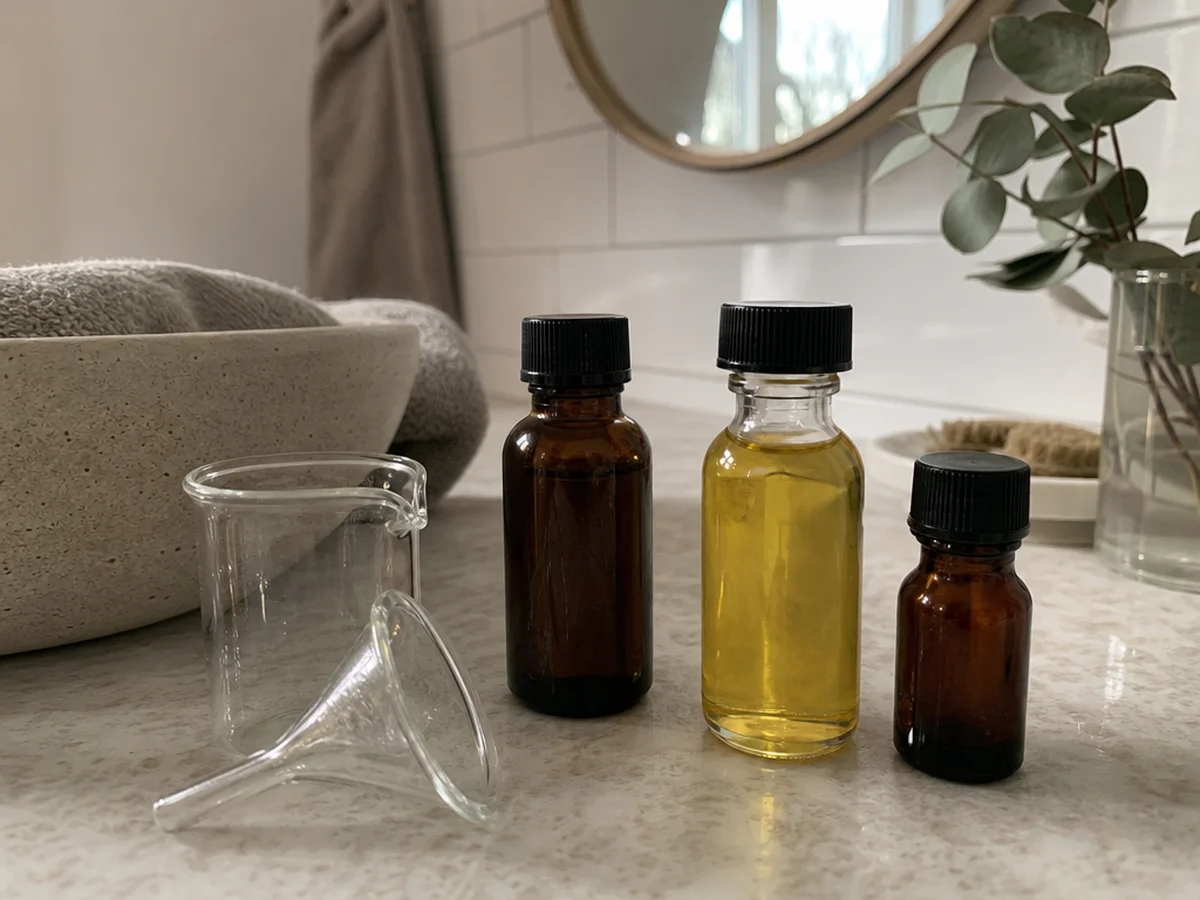
- Weigh the carrier into a clean dark glass bottle, then add the oil by drops or weight.
- Cap, tilt gently to mix, and label it with the oil, the percentage and the date.
- Store away from heat and light. The Tisserand Institute names oxygen, light and heat as the causes of oxidation, so a cool cupboard beats a sunny bathroom shelf. Our storage article goes into more detail.
Making it a pleasure to use
A beard oil is something you touch every day, so small habits matter as much as the recipe. Put a few drops in your palm, rub your hands together, and work it in from the roots out to the ends until your beard feels lightly conditioned, not slick. If you can see a shine from across the room, you used too much. Start with less than you think you need; you can always add a little more tomorrow, but you cannot take it back.
Notice the scent a few minutes after applying, not only in the first second. Cedarwood is a base note, so what you smell on the way out the door is the quiet, dry-woody part, and that is usually the bit people like. If it feels too present, that is useful information: drop to a lower percentage in your next batch.
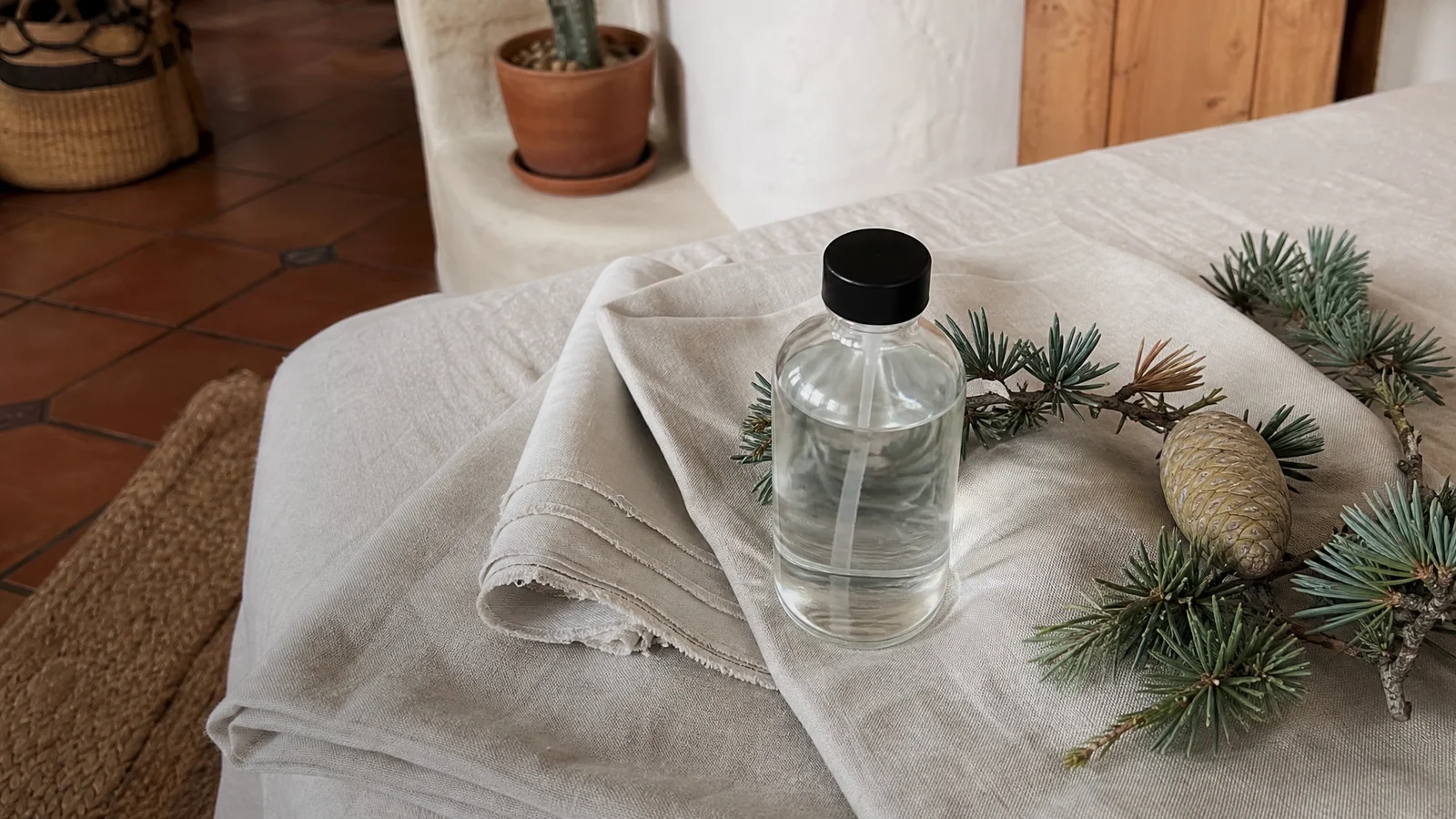
A dark glass bottle with a dropper or pump is a good home for it, and it keeps the dose steady from one morning to the next.
Which oil for a beard
Scent decides. We describe the Atlas as dry, woody and warmly sweet, the Himalayan as softer and more resinous, and the Virginian as sharp like fresh pencil shavings. Most of the safety literature is about Virginian oil, so for the other three the evidence is thinner, which is one more reason to keep the dose light and patch test every batch on your inner forearm.
If you have eczema or a fragrance allergy, ask a dermatologist or pharmacist before trying it. If you are pregnant, nursing or have a medical condition, check with your physician. Stop at the first sign of irritation. For the wider picture, see the safety article, the patch test article and the massage oil for body skin.
If you plan to sell your blend, the FDA notes that a retail cosmetic needs an ingredient list, and fragrance ingredients can be listed simply as "Fragrance"; labeling and safety remain the maker's responsibility, so a regulatory professional is the person to ask.
A beard oil is a scent product at heart. Keep it light, keep it low, and label it so you know exactly what is in the bottle.
Cedarwood Essential Oil
Cedarwood Essential Oil from our own shop, in sizes from 0.5 oz to bulk.
From $9.99
Shop Now →Sources & Further Reading
- Dilution for essential oils, Tisserand Institute
- Cedarwood essential oil (Cedrus spp.): a forgotten pharmacological resource with emerging therapeutic potential, Exploration of Drug Science, 2025
- Dose-response assessment of the dermal toxicity of Virginia cedarwood oil in F344/N rats and B6C3F1/N mice., Food and Chemical Toxicology, 2016
- Oxidative Stability and Antioxidant Activity of Crude Jojoba Oil, BPB Reports, 2022
- Oxidation and the Shelf Life of Essential Oils, Tisserand Institute
- Fragrances in Cosmetics, FDA