How to Patch Test Cedarwood Oil at Home, Step by Step
A patch test is the best five-minute habit in oil use, and it costs nothing. It tells you how a particular dilution behaves on a small patch of your skin before you commit it to a scalp, a beard or a massage. Here is how to do it well, what it can and cannot tell you, and when to hand the question to a dermatologist.
Cedarwood Essential Oil
Our own Cedarwood Essential Oil, in sizes from 0.5 oz to bulk.
From $9.99
Shop Now →Two kinds of reaction
The NHS describes contact dermatitis as skin that turns itchy, blistered, dry and cracked, usually within a few hours or days of meeting an irritant or allergen (Contact dermatitis - NHS). Irritation is direct and can happen to anyone given too strong a dose, which is why we always dilute. Allergy takes a first exposure to prime the immune system and a later one to trigger it, so it can show up after a pause. Cedarwood is documented on the allergy side: a 2021 dermatology review lists cedarwood oil among essential oils with reported contact dermatitis, and notes that about 80 essential oils have been shown to cause contact allergy (Art of Prevention: Essential Oils - Natural Products Not Necessarily Safe). Nobody should read alarm into that. It is the reason a quick test is worth having.
A home test, step by step
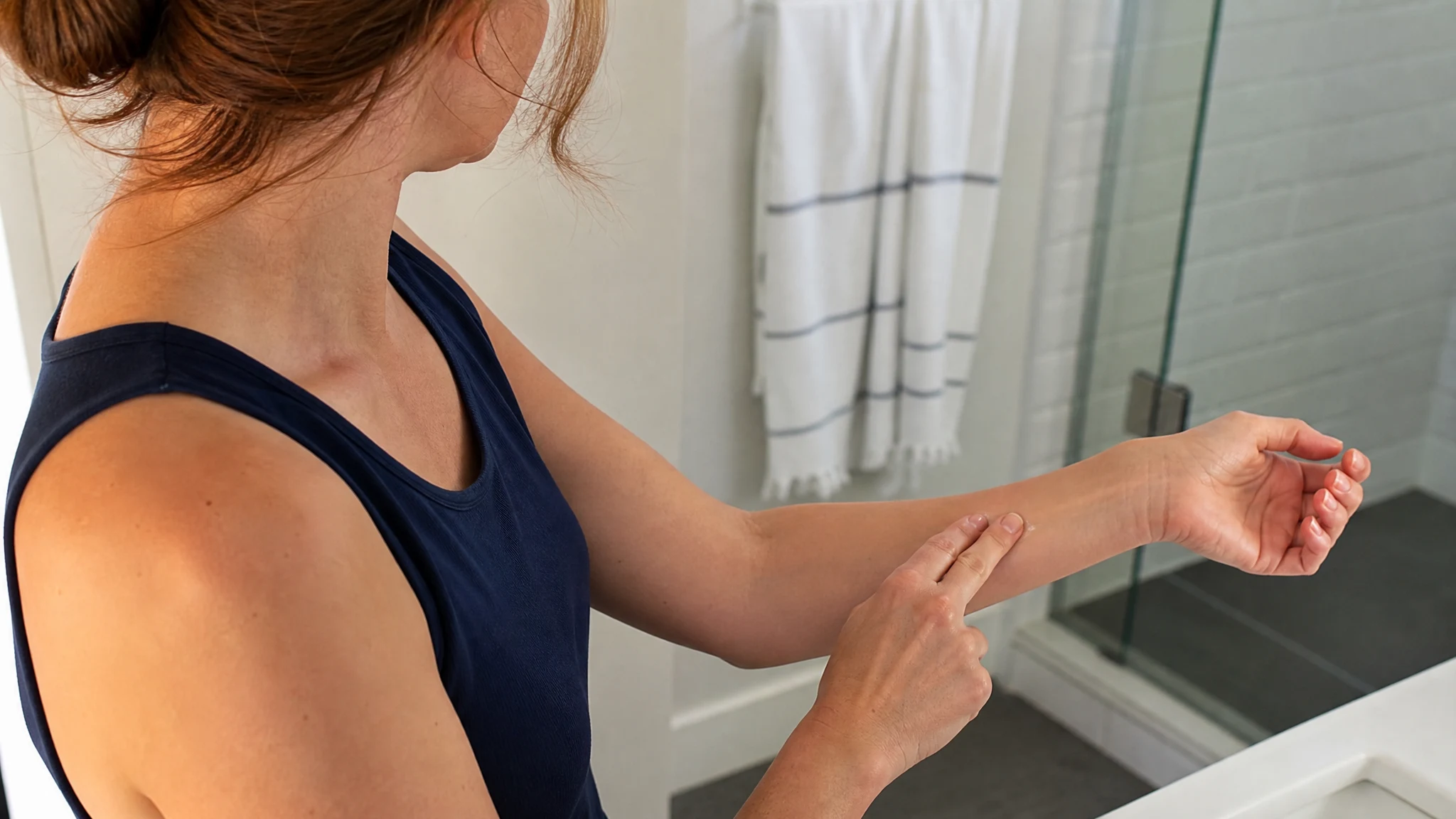
The American Academy of Dermatology describes a simple way to test a skin care product: choose a quarter-sized spot where the product will not be rubbed or washed away, such as the underside of the arm or the bend of the elbow, apply your normal amount twice a day for seven to ten days, and stop and wash it off if redness, itching or swelling appears (How to test skin care products). That advice is for finished products, so adapting it for a homemade cedarwood blend is our suggestion:
- Dilute first. Our guidance for all four oils is 0.5% to 2% in a carrier oil, and we start at the low end. By arithmetic at about 20 drops per ml, 10 ml of carrier takes 1 drop for 0.5%, 2 drops for 1% and 4 drops for 2%. Weigh it if you can, since droppers vary.
- Test the blend you will really use, at the strength you will really use.
- Add a control spot of the plain carrier alongside. If both patches redden, the carrier or the rubbing is the cause.
- Follow the seven to ten day routine, not a single dab for an afternoon.
- Keep neat oil off your eyes and wash your hands after handling it.
Carrier oils come from a pharmacy, grocery or craft shop, since we sell only the oils.
What the test cannot promise
A week and a half of testing covers a short stretch of a habit you may keep for months. Because allergy can develop with repeated contact, our reasoning is that a clear test is encouraging and not a lifetime guarantee, so keep an eye on your skin as you go. If you plan to use cedarwood on the scalp or in a beard every day, treat the first month as an extended test: begin at 0.5% and stop at the first itch.
The oil's age matters too. The dermatology review says ageing can produce byproducts such as hydroperoxides that are more sensitising, and advises testing against a person's own products because composition can change over time. A 2025 review of cedarwood oil links sensitisation to oxidised or poor-quality oil (Cedarwood essential oil (Cedrus spp.): a forgotten pharmacological resource with emerging therapeutic potential). In practice, that means keeping the bottle tightly capped in a cool, dark place, as we describe in our storage article, and repeating a quick test if an old bottle smells different.
When a clinic test makes sense
If you react to a blend with several ingredients, a forearm test cannot say which one was responsible. That is what a dermatologist's patch test is for. The AAD explains that a dermatologist places small amounts of suspected allergens under patches, usually on the back, that stay on for 48 hours, with a follow-up visit several days later because reactions can take that long to appear (Patch testing can find what's causing your rash). The dermatology review adds that specific oils should be tested because fragrance mixes alone are not enough. If you go, bring the bottle and say which cedarwood it is, Atlas, Himalayan, Virginian or Texas, and let the clinician set the concentration. We keep the species named on each of our product pages for just this reason.
Keeping a simple log
A scrap of paper makes the test easier. Write the date, the oil and the percentage, then add a quick note each day: nothing, a little pink, itchy. It sounds fussy, but a week on, memory gets hazy, and a note will show you whether a spot is changing. Take a photo in the same light each day if you like.
Know when to stop
- Itching, redness, swelling or blistering where you applied it: wash off and stop. See a dermatologist if a reaction is severe or you cannot work out the trigger.
- Oil in the eyes: rinse with plenty of running water and get medical advice if symptoms persist.
- Trouble breathing after exposure: treat it as an emergency, as America's Poison Centers advises (Essential oils: Poisonous when misused | Poison Control).
The Certificate of Analysis we publish for one Atlas batch lists density, refractive index and best-by date. If you need allergen or composition information for any of our four oils, ask us in writing through the contact page before ordering. For recipes and ratios, see our guides to diluting cedarwood oil and beard oil, and for the wider picture our safety overview.
Done well, a patch test is a small act of care that lets you enjoy cedar's scent with a clear conscience.
Cedarwood Essential Oil
Cedarwood Essential Oil from our own shop, in sizes from 0.5 oz to bulk.
From $9.99
Shop Now →Sources & Further Reading
- Contact dermatitis - NHS
- How to test skin care products (American Academy of Dermatology)
- Patch testing can find what's causing your rash (American Academy of Dermatology)
- Art of Prevention: Essential Oils - Natural Products Not Necessarily Safe (Sindle and Martin, Int J Womens Dermatol, 2021)
- Cedarwood essential oil (Cedrus spp.): a forgotten pharmacological resource with emerging therapeutic potential (Gonçalves, Exploration of Drug Science, 2025)
- Essential oils: Poisonous when misused | Poison Control