Cedarwood Oil for Hair Oils: Scent, Drops and Dilution
Walk past a barbershop and you will probably catch it: the dry, woody smell of cedar rising from a bottle of grooming oil. That is where cedarwood belongs in hair care, as a fragrance, in a small amount, in a carrier oil you already like. This article is about getting that part right, with the arithmetic, the choice among our four oils and a few habits that keep a scented scalp oil comfortable.

Cedarwood Essential Oil
Our own Cedarwood Essential Oil, in sizes from 0.5 oz to bulk.
From $9.99
Shop Now →Cedarwood as a scent, not a promise
You may have seen a 1998 trial in which people with alopecia areata, a patchy hair loss condition, massaged their scalps daily for seven months with either a blend of four oils (thyme, rosemary, lavender and cedarwood in jojoba and grapeseed oils) or the carrier oils alone (Randomized trial of aromatherapy. Successful treatment for alopecia areata). Because the oils were tested together, none of the result can be assigned to cedarwood, and it involved a medical condition that deserves a dermatologist. We think of cedarwood in hair products as a fragrance, and we make no claim that it changes hair. For any scalp concern, a dermatologist is the right call. If you are curious how cedarwood compares to rosemary, our comparison article goes through it.
Choosing the oil for the scent you want
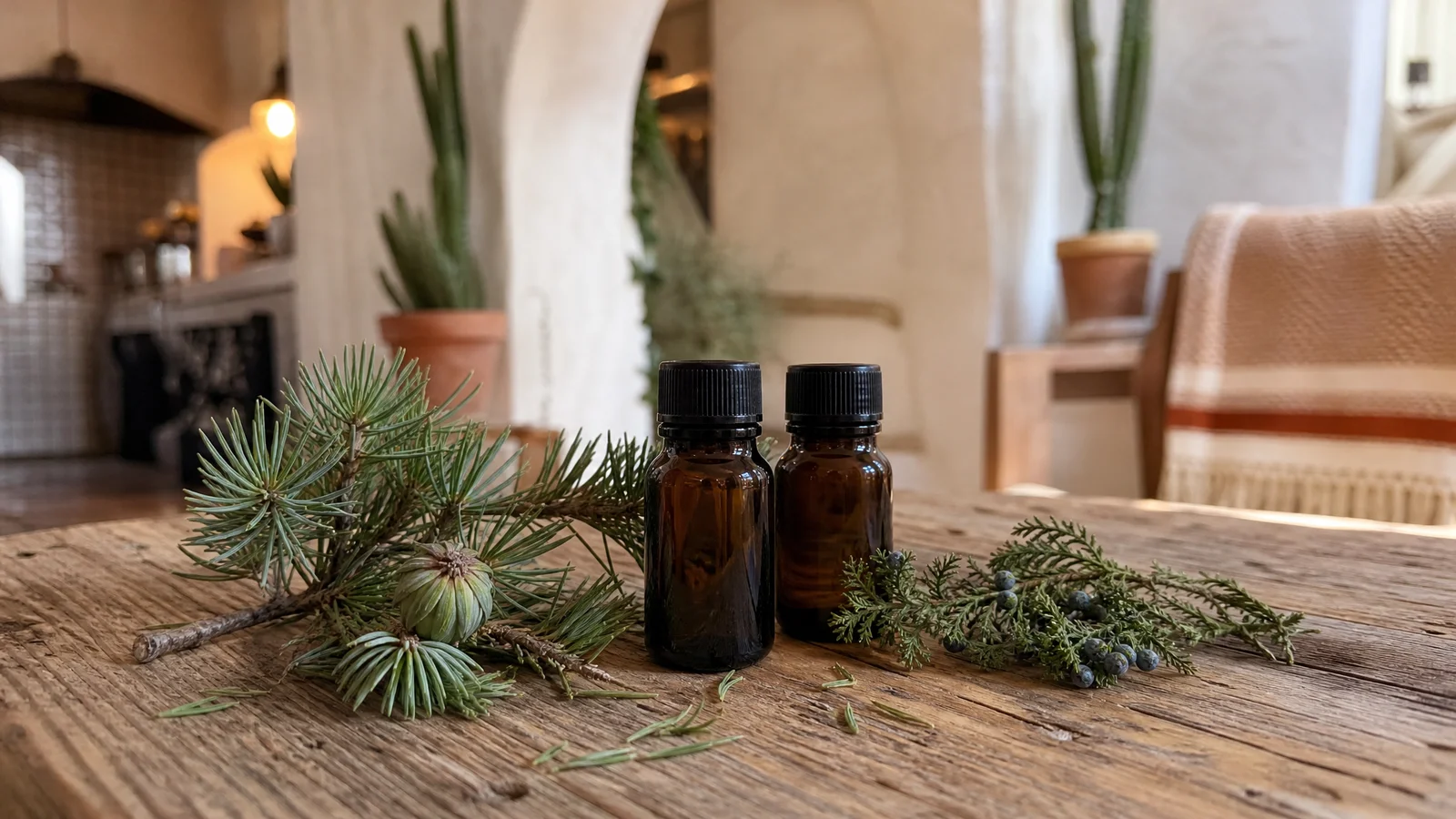
This is the enjoyable part. Our Virginian oil (Juniperus virginiana) is dry, sharp and classically like fresh pencil shavings, the barbershop note. Atlas (Cedrus atlantica) is dry, woody and warmly sweet with a balsamic depth. Himalayan (Cedrus deodara) is warm, sweet and softly resinous, and Texas is soft, smooth and gently sweet. They are different materials: a survey of commercial wood oils found Virginian-type oils built mostly on cedrenes, thujopsene and cedrol, while Atlas oils are built on himachalenes (Cedarwood Oils: The Wood Essential Oil Compositions from Trees Known as "Cedar"). That is why we describe each oil on its own terms.
The dilution arithmetic
We sell our oils neat, so the maths is yours. Our guidance for skin is 0.5% to 2% in a carrier oil. Here is that range worked out for a 30 ml (1 oz) bottle, at about 20 drops per ml (droppers vary, so weighing is more accurate):
| Strength | Oil in 30 ml carrier | Approximate drops |
|---|---|---|
| 0.5% | 0.15 ml | 3 |
| 1% | 0.30 ml | 6 |
| 2% | 0.59 ml | 12 |
For a daily scalp oil, we start at the bottom of that range. Published skin data on Virginia cedarwood oil is the reason. In a 13-week study on rats and mice, the oil in ethanol caused skin changes at the application site, and the benchmark dose limits ran from about 0.65% to 4.4%, which the authors said overlaps with concentrations used in cosmetic products (Dose-response assessment of the dermal toxicity of Virginia cedarwood oil in F344/N rats and B6C3F1/N mice). That was animal data with an ethanol vehicle, so it is no hair-oil limit. A 2025 review offers 2% or less as an example for leave-on products and notes that it is not a cedarwood-specific standard (Cedarwood essential oil (Cedrus spp.): a forgotten pharmacological resource with emerging therapeutic potential). So 3 drops per ounce is where we would begin, and we would not call the top of the range a safe level. For your own formulation, your dermatologist or a professional formulator can give you a ceiling.
Picturing the finished bottle
Before you measure anything, think about how you want the oil to feel on a normal morning. A light carrier makes a thin oil that you can smooth through the ends in seconds, while a richer one gives more weight and a slower feel. Whichever you choose, the cedar is only a whisper in the background. You will notice the scent most when you first rub the oil between your palms, and again faintly through the day as it settles.
That is why we favour restraint. A hair oil that smells like a quiet cedar drawer is a pleasure, while one that smells overpowering is hard to live with. If you want a more rounded scent, try the Atlas or Himalayan, which feel softer than the Virginian, and smell your finished oil the next day before you decide whether it needs anything more.
A comfortable way to start
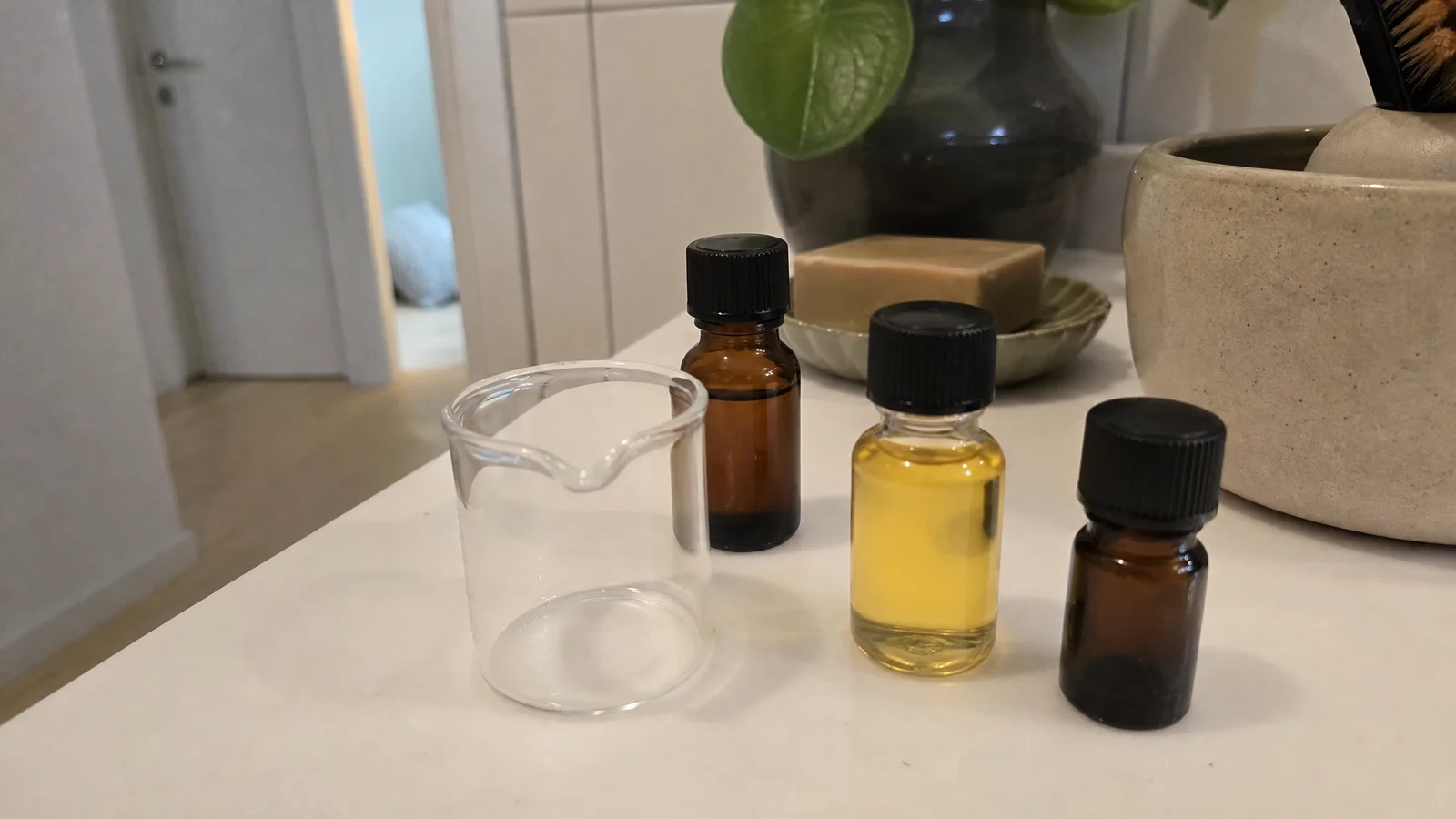
- Pick up a carrier oil elsewhere. We do not sell jojoba, argan or other carriers, but a pharmacy, grocery or craft supply shop does.
- Mix a small bottle at 0.5% and write the date on it.
- Patch test first. Our patch test article shows how.
- Begin on the lengths and ends of the hair, away from the scalp and the eyes, and stop if you notice itching, redness or burning.
- Wash your hands afterwards and keep the bottle capped, cool and out of reach of children and pets.
Rinse-off products such as shampoo involve shorter contact than a leave-on oil, which is reasoning on our part rather than a measured result for cedarwood. A beard oil is the same arithmetic at a smaller scale, and our beard oil article works through it. If you are pregnant, nursing or have a medical condition, please check with your physician before using essential oils.
A good cedar hair oil is mostly about restraint: a little oil, a carrier you like and a scent that makes the bathroom smell like a forest edge.
Cedarwood Essential Oil
Cedarwood Essential Oil from our own shop, in sizes from 0.5 oz to bulk.
From $9.99
Shop Now →Sources & Further Reading
- Randomized trial of aromatherapy. Successful treatment for alopecia areata (Hay et al., Arch Dermatol, 1998)
- Cedarwood Oils: The Wood Essential Oil Compositions from Trees Known as "Cedar" (Setzer and Satyal, Plants, 2026)
- Dose-response assessment of the dermal toxicity of Virginia cedarwood oil in F344/N rats and B6C3F1/N mice (Catlin et al., Food Chem Toxicol, 2016)
- Cedarwood essential oil (Cedrus spp.): a forgotten pharmacological resource with emerging therapeutic potential (Gonçalves, Exploration of Drug Science, 2025)