Cedarwood Body Mist: A Woody Scent for Summer Nights
Search for a cedarwood bug spray and you will find plenty of recipes, but a spray with cedarwood oil in it is, honestly, a woody-scented spray. What it is good at is smelling like a porch swing in a cedar grove, and that is what we would build it for.

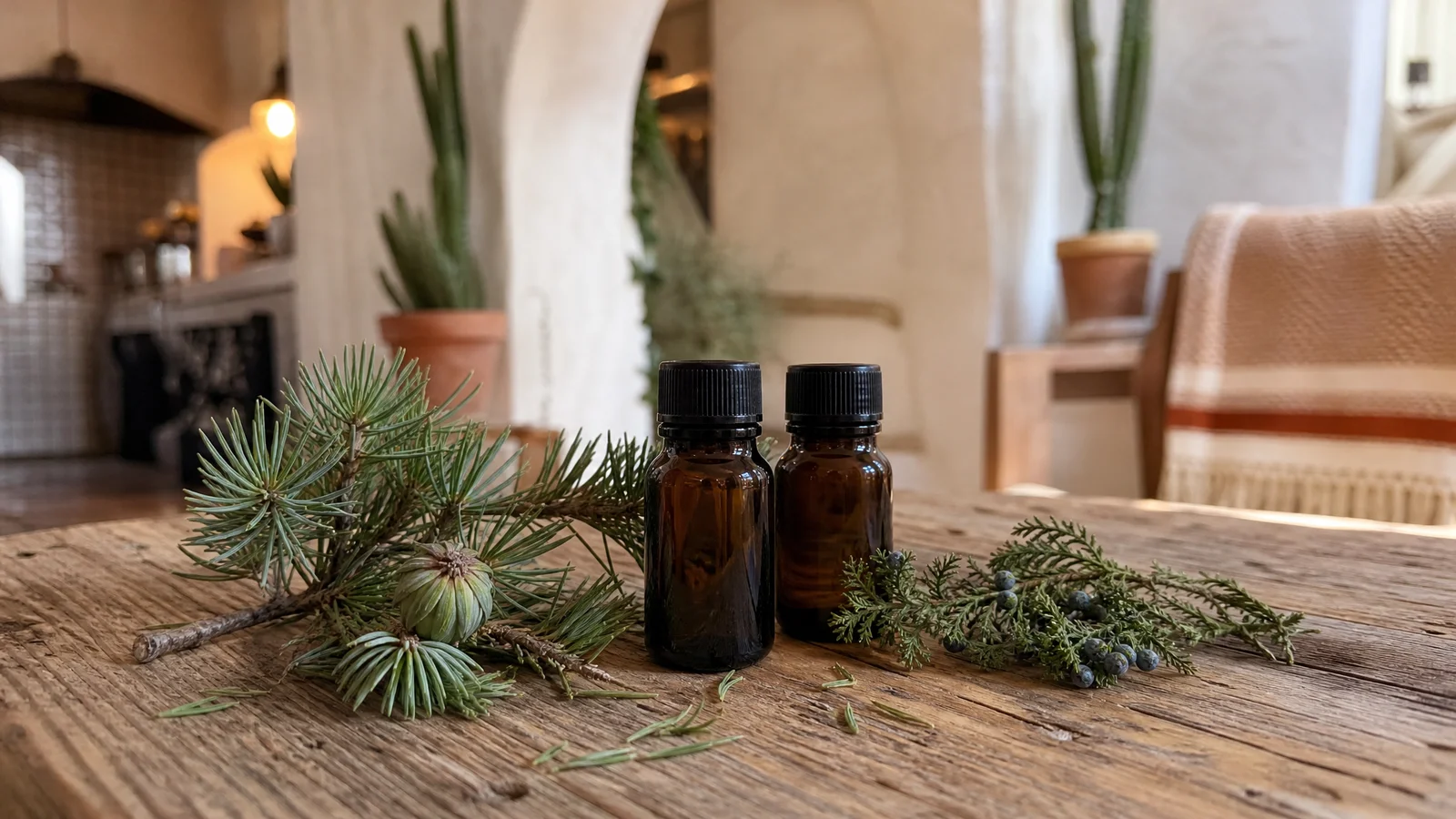
Cedarwood Essential Oil
Our own Cedarwood Essential Oil, in sizes from 0.5 oz to bulk.
From $9.99
Shop Now →Why we call it a scent, not protection
The CDC states it plainly: "We do not know the effectiveness of non-EPA registered insect repellents, including some natural repellents." Where mosquitoes or ticks can carry disease, the CDC points people to EPA-registered repellent ingredients, which you will find at a pharmacy. We hold no pesticide registration and make no pest claim for any of our oils, so please do not put one on a label you write for yours. Our insect repellent article and the DEET comparison go through the evidence.
What remains is a pleasant body or porch mist, and it is a nice thing to make.
How much oil a skin mist should carry
Our dilution guidance is 0.5% to 2% in a carrier, with a patch test first and a start at the low end. For a spray that goes over a large area of skin, we would stay at 0.5%, and lower still near the face. A 2025 review of cedarwood oil cites 2% as a ceiling for leave-on products while noting that regulators give limited guidance, and a 13-week rodent study with Virginia cedarwood oil found skin lesions at levels that overlap with cosmetic use. Those are reasons to start small, not to chase a stronger smell.
| Batch weight | Oil at 0.5% | As Atlas oil, by volume | Oil at 1% |
|---|---|---|---|
| 50 g | 0.25 g | about 0.27 ml, 5 drops | 0.5 g |
| 100 g | 0.5 g | about 0.54 ml, 11 drops | 1.0 g |
| 250 g | 1.25 g | about 1.34 ml, 27 drops | 2.5 g |
The drop figures are our arithmetic: the batch of Atlas oil on our certificate of analysis had a density of 0.934 at 20 C, with about 20 drops per ml. Droppers vary, so weigh the oil on a scale reading to 0.01 g. We publish no density for the Himalayan, Virginian or Texas oils, so weigh those too.
Making it
- Weigh the oil into a clean container first.
- Add a solubilizer (a polysorbate or similar) from a craft or cosmetic-supply shop and stir until uniform before any water goes in. The ratio comes from that supplier's data sheet; ask them for their stated rate for essential oils.
- Add distilled water slowly while stirring, up to the total weight.
- Check after a day. A cloudy or separated mix means too little solubilizer. Shaking does not fix it.
Here is why this matters: oil that has not dissolved lands on skin as droplets, so the spot it touches is far stronger than the 0.5% on the label. That is reasoning, not a studied result, but it is the best argument against plain oil in water with "shake well" written on it.
The spray bottle and a preservative both come from a supply shop (ask the bottle maker whether the plastic suits essential oils). Anything with water in it can grow microbes, so make only what you will use soon, and follow your preservative supplier's directions for rate.
Using it well
A body mist is a light-handed thing. Hold the bottle at arm's length, give one or two sprays toward the air in front of you and walk through them, or spritz the front of a shirt or a scarf instead of soaking skin. Keep the spray away from your face, and close your eyes and mouth if you are anywhere near it. Wait a minute before you judge the scent: the first sniff is brightest, and the dry-down is the part you will actually live with. Test a hidden patch of fabric first, since a mist with oil in it can mark pale or delicate cloth.
Setting the scene
The fun of a cedar mist is the picture it paints: a porch at dusk, a screen door, a cold drink and the faint smell of dry wood. Cedar sits well beside citrus and other warm, sweet notes, and our Himalayan oil blends well with sweet orange, so a lighter, sunnier evening scent is easy to imagine. If you add another oil from a supply shop, add one thing at a time so you can tell what changed, and count every oil you add toward the total share you chose.
Labeling and who should skip it
Write the oil's name, the percentage, the date and "external use only, keep away from eyes, children and pets" on the bottle, and keep a weight record of each batch so the percentage can be checked later. Skip it for a child, and ask a veterinarian before using any scented spray near a pet, cats especially (see the cat article). If you are pregnant, nursing or have a medical condition, check with your physician first, and if you have a history of fragrance reactions, ask a dermatologist or allergist.
Which oil
Choose by smell. We describe the Atlas as dry, woody and warmly sweet, the Himalayan as warm and softly resinous, the Virginian as dry and pencil-shaving sharp, and the Texas as soft and smooth. For a room or linen version, try the linen mist tutorial.
A cedar mist for a summer evening is a lovely idea; just let it be that, and keep the pharmacy repellent for the bites.
Cedarwood Essential Oil
Cedarwood Essential Oil from our own shop, in sizes from 0.5 oz to bulk.
From $9.99
Shop Now →Sources & Further Reading
- Preventing Mosquito Bites, CDC
- Cedarwood essential oil (Cedrus spp.): a forgotten pharmacological resource with emerging therapeutic potential, Exploration of Drug Science, 2025
- Dose-response assessment of the dermal toxicity of Virginia cedarwood oil in F344/N rats and B6C3F1/N mice., Food and Chemical Toxicology, 2016