Cedarwood vs Vetiver Oil: Dry Timber or Damp Earth?
Open a bottle of vetiver and you smell a turned-over garden after rain: dark, earthy, a little smoky. Open a cedarwood and you smell a pencil sharpener or a clean drawer. Both sit at the bottom of a blend, both are used to give lighter oils something to hold on to, and they are not interchangeable. Our view is simple: cedarwood is the dry timber frame, vetiver is the deep shadow behind it, and the best blends often use a little of each.
Cedarwood Essential Oil
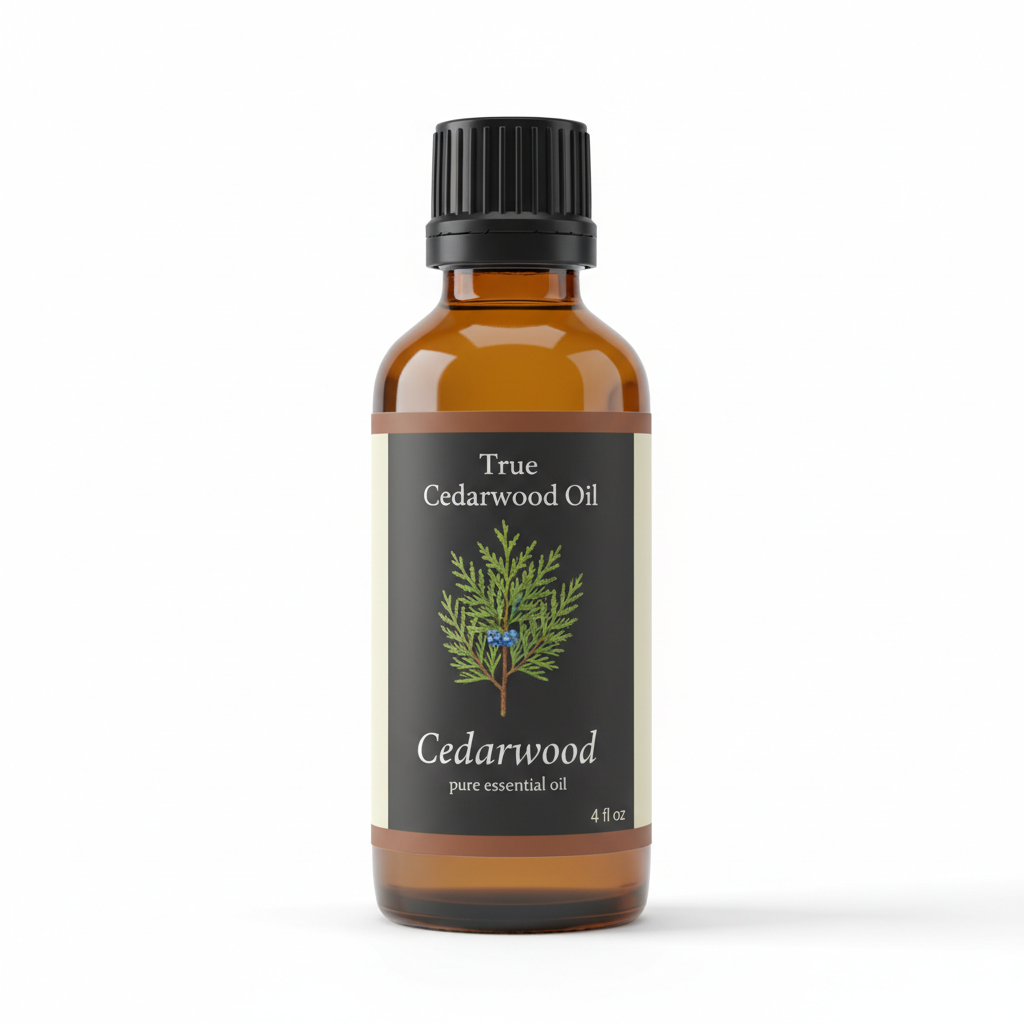
Our own Cedarwood Essential Oil, in sizes from 0.5 oz to bulk.
From $9.99
Shop Now →A tree's wood against a grass's roots
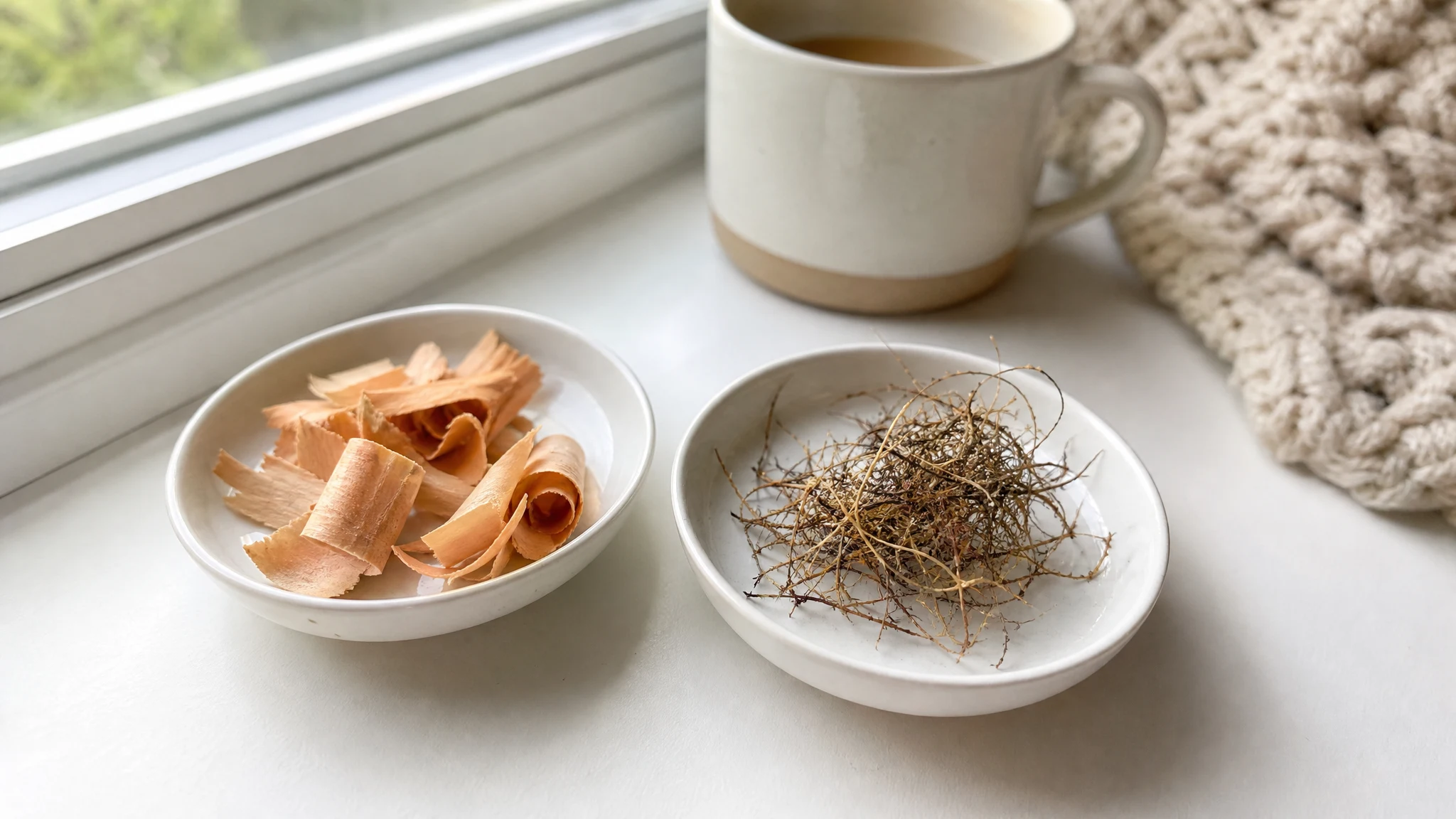
Cedarwood oil comes from wood. Vetiver oil comes from the roots of a tall tropical grass, and a 2024 review in the Indian Journal of Pharmaceutical Sciences describes the root as the plant's most economically important part. That difference in raw material explains most of what you smell. The same review notes that traditional hydro-distillation of the roots can run for around 12 hours, and that vetiver oil contains over 300 identified chemicals, with a single analysis finding about 110 components, mostly sesquiterpenes and their oxygen-bearing relatives.
Cedarwood is also a sesquiterpene story, just with a different cast. A 2026 review of cedarwood oils reports that our two true cedars (Atlas and Himalayan) are led by himachalenes, with beta-himachalene averaging 40.3 percent in 48 commercial Atlas oils, while the juniper cedarwoods (our Virginian and Texas oils) lean on cedrene, thujopsene and cedrol. Vetiver's signature is different again: khusimol, which that review puts anywhere from about 12.7 to 30 percent depending on the sample, with vetivones reported alongside it. Same family of molecules, different personalities.
How thick is thick?
This is the difference you notice at the bench before you smell anything. The vetiver review describes a Thai oil as a "viscous light-brown oil" and gives the Bureau of Indian Standards range for specific gravity as 0.9926 to 1.0444, so vetiver oil can be about as dense as water or slightly denser. The one Atlas batch on our published Certificate of Analysis measured 0.934. These are different batches and different methods, so treat it as an illustration, but it does line up with the feel of the two: cedarwood pours, vetiver creeps.
That matters when you measure. A thick oil clings to a bottle neck and falls in slow, fat drops, so a drop-count recipe written for one oil does not transfer cleanly to the other. If you are mixing a recipe that matters, weigh it. Our dilution arithmetic uses roughly 20 drops per millilitre, and for a thick oil that is only a rough convention. Vetiver is a specialist item we do not sell, so look for it at an aroma or craft supply shop, and ask for the botanical name, Chrysopogon zizanioides, on the label.
Which one holds a blend together?
Both do, in different ways. The vetiver review says the oil's persistence makes it valuable as a fixative alongside other scents. We say much the same of our Atlas oil, which we describe as a fixative that deepens blends of bergamot, lavender, vetiver and rose. In fact vetiver is on the pairing list of all four of our cedarwood oils, so we think of the two as natural partners rather than rivals.
The practical difference is how much you need. Cedarwood is a backbone: it straightens a sweet or citrusy blend and dries it out. Vetiver is a tone: a little deepens and darkens everything. Our recommendation is to start vetiver at about one-third the number of drops of cedarwood, then adjust by nose.
A blend to try, with the arithmetic
Here is a suggestion for a diffuser blend of 6 drops total (the bergamot and vetiver come from an aroma or craft supply shop): 3 drops Virginian cedarwood, 1 drop vetiver and 2 drops bergamot. That is a 3 : 1 : 2 ratio. Scaled up for a bottle of mixed oil to use in several diffuser sessions, multiply each number by ten for 60 drops, and keep it in a small bottle with a plain cap. This is a recipe built from the guidance above, not a tested formula, so smell it on a paper strip first.
If you would rather wear it, the maths changes. At a 1 percent skin blend in 10 ml of carrier, you have 0.1 ml of essential oil, which is about 2 drops. One drop of cedarwood and one of vetiver is therefore already the whole budget, so keep skin blends small. Our guidance for general skin use is 0.5 to 2 percent in a carrier oil. Dilute, patch test, and if you are making something to sell, check the current IFRA standards for the specific oils in your formula, because limits vary by oil and product type.
Which of ours to put next to vetiver
- Virginian, Juniperus virginiana, for contrast: the "dry, sharp, classically pencil-shaving" edge sets off vetiver's damp earth.
- Himalayan, Cedrus deodara, for harmony: we describe it as warm, sweet and softly resinous, so it sits closer to vetiver's depth.
- Atlas, Cedrus atlantica, and Texas sit in between, and both list vetiver as a partner.
For more on how the four of ours differ, see what cedarwood oil smells like, the comparison of our four cedarwoods and what to blend with cedarwood, and in what ratios. If base notes interest you, cedarwood in perfumery goes further, and cedarwood in a diffuser covers the room-scent side.
Smell them side by side on two paper strips and you will not need anyone to tell you which is which. One is the room, and the other is the weather outside it.
Cedarwood Essential Oil
Cedarwood Essential Oil from our own shop, in sizes from 0.5 oz to bulk.
From $9.99
Shop Now →Sources & Further Reading
- Pandey A, Tiwari SC. A Review on Chemical Composition, Oil Quality, and Bioactivity of Vetiver Essential Oil. Indian Journal of Pharmaceutical Sciences, 2024.
- Setzer WN, Satyal P. Cedarwood Oils: The Wood Essential Oil Compositions from Trees Known as "Cedar". Plants (Basel), 2026.