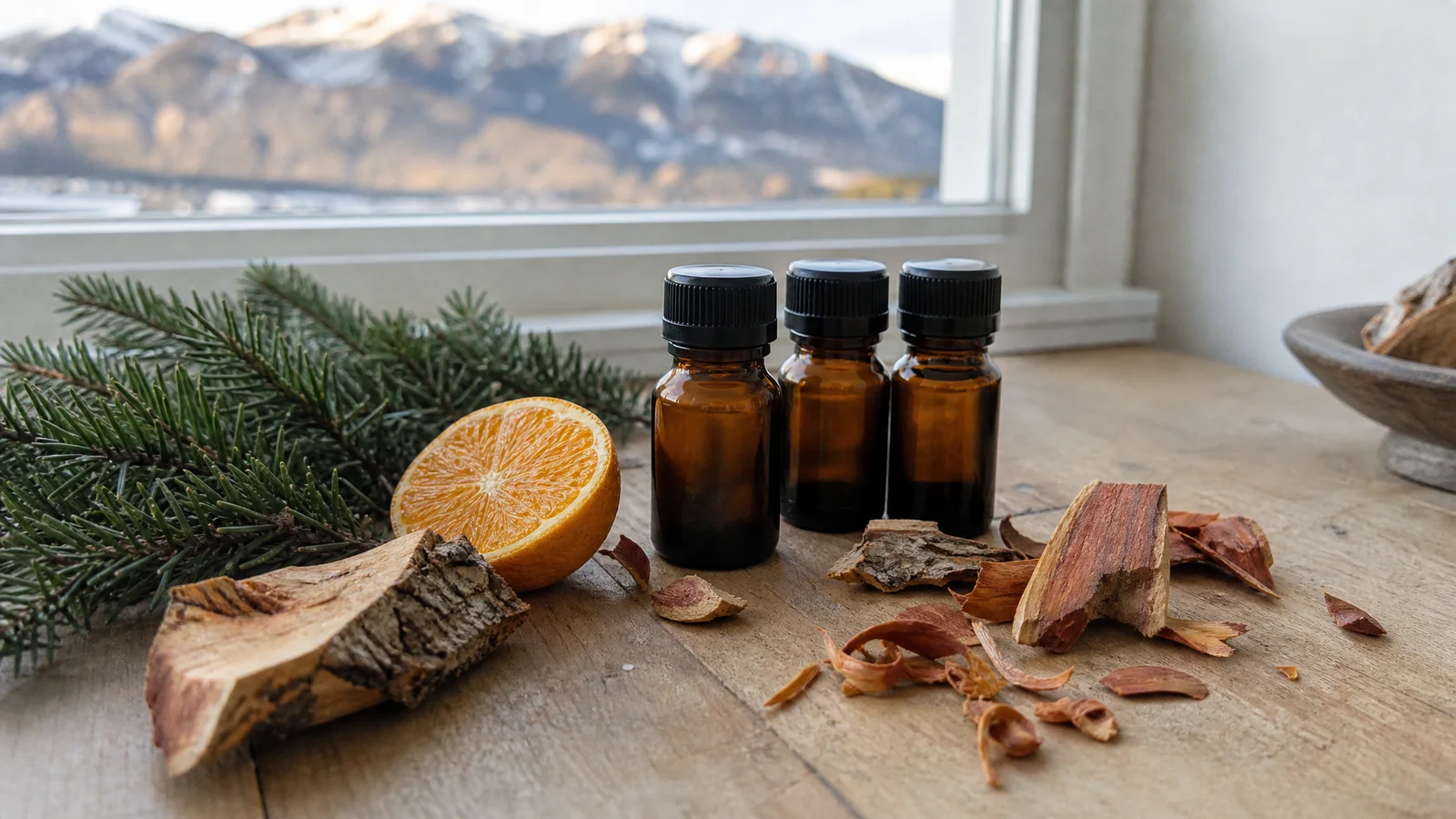
What to Blend With Cedarwood Oil, and in What Ratios
Lists of the best oils to blend with cedarwood are easy to write and hard to use, because the pairing advice is all taste and the percentages are an afterthought. We would rather start with what we actually recommend for each of our four cedarwood oils, see which partners keep turning up, and then run the one piece of arithmetic that decides whether you can use them at the strength you have in mind.

Cedarwood Essential Oil
Our own Cedarwood Essential Oil, in sizes from 0.5 oz to bulk.
From $9.99
Shop Now →Who we pair with what
Each of our cedarwood pages lists the oils it blends well with. Tallying them gives eleven partners:
| Partner | Our cedarwood oils that list it |
|---|---|
| Bergamot | Atlas, Himalayan, Virginian, Texas |
| Vetiver | Atlas, Himalayan, Virginian, Texas |
| Lavender | Atlas, Virginian, Texas |
| Sandalwood | Atlas, Himalayan, Texas |
| Clary sage | Atlas, Himalayan, Texas |
| Patchouli | Himalayan, Virginian |
| Rose | Atlas |
| Sweet orange | Himalayan |
| Rosemary | Virginian |
| Cypress | Virginian |
| Juniper berry | Texas |
Bergamot and vetiver show up for every one of our cedarwoods, so they are the safe first pairings. Beyond that, the pattern follows character. The juniper-based Virginian leans toward woody and herbal company, the Atlas toward florals like rose, and the Himalayan toward sweet and soft partners. Our four oils are not interchangeable in a recipe, so it helps to pick the cedarwood first. Our family overview lays out the four. We do not sell the partner oils, so find them at an aromatherapy or perfumery supplier.
Why a partner can change the percentages
A blend on skin has one dilution ceiling for the whole mixture, and each oil inside it can have a lower limit of its own. On the cedarwood side, our guidance is 0.5% to 2% in a carrier with a patch test, and we start at the lower end. The Tisserand Institute's dilution guide gives 0.2% to 1% for sensitive skin, 0.5% to 1.2% for facial products and 1% to 3% for body oils. A 13-week animal study of Virginia cedarwood oil in ethanol (Catlin et al., 2016) found skin lesions at the application site, with lower dose estimates starting at 0.65%, which is another reason we do not call 2% safe.
Now the partner side. The Tisserand Institute's phototoxicity page says most phototoxic essential oils are expressed citrus oils, and that IFRA limits bergamot oil to 0.4% in the final leave-on product applied to sun-exposed skin. Bergapten-free bergamot is treated as non-phototoxic. That changes a classic pairing in a real way:
- A 1% blend that is half cedarwood and half expressed bergamot has 0.5% bergamot, which is above 0.4%.
- The same 1% blend at 40% cedarwood and 30% bergamot has 0.40% cedarwood and 0.30% bergamot, and leaves 30% of the concentrate for a third oil. Bergamot is now under the figure.
If the product is washed off, or the bergamot is bergapten-free, that constraint relaxes, so ask your supplier which you have. For the other ten partners we did not look up a dermal limit, so we cannot quote one. The practical rule is to find each partner's own safety documentation from your supplier, hold the whole blend to the lowest ceiling in it, and patch test.
Setting the ratio in the right order
Work backwards, the way you would at a purchasing decision. Fix the finished strength from the lowest ceiling in the blend. Write each oil as a share of the concentrate and multiply: share times strength gives each oil's percentage in the finished product. Check every oil against its own limit, adjust until all pass, and only then judge the smell. Weigh in grams instead of counting drops, because the Tisserand guide notes that no two drops of essential oil are the same. Done in that order, the smell never talks you into a number the safety data does not support.
Three pairings, worked on paper
Cedarwood and lavender as a room scent. No skin ceiling applies in a diffuser, but a 2025 pilot study of household diffusers (using tea tree oil, not cedarwood) found heat diffusers gave roughly ten times the terpene levels of ultrasonic ones. Keep sessions short and the room ventilated.
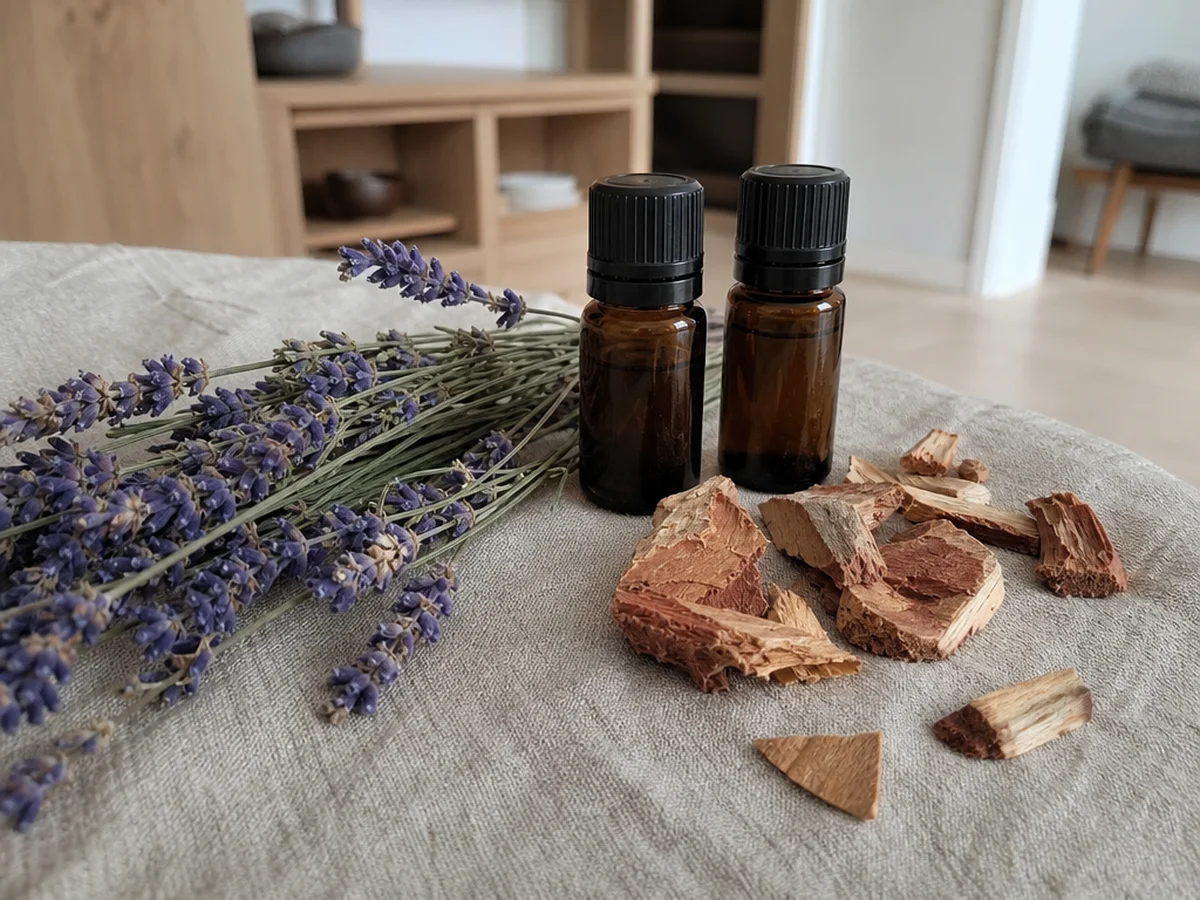
Cedarwood and bergamot on skin. At a 1% total blend with 25% bergamot and 40% cedarwood, you get 0.25% bergamot and 0.40% cedarwood in the finished oil. Choose a bergapten-free bergamot or keep it off sun-exposed skin.
Cedarwood and vetiver as a base accord. Both are base notes, so this pairing has no top note and comes across as quiet and long lasting. Our perfumery article explains why, and our sandalwood comparison covers swapping one base note for another.
The species inside your blend
A blend written for "cedarwood" assumes the oil is interchangeable, and it is not. A 2026 review of published compositions reports that Atlas and Himalayan oils are dominated by himachalenes and atlantones, while Virginian oil is dominated by cedrenes, thujopsene and cedrol. The Texas oil carries a species-name disagreement across sources, and a juniper-berry partner keeps that blend within one plant family, which is a matter of smell. A European Food Safety Authority assessment of a Texas cedarwood oil classed it as an irritant to skin and eyes, so the same care applies.
Training your nose before you mix
Blending is far more about patience than about recipes. Before you combine anything, smell each oil on its own, on a paper strip, and note what you find in a few words: dry, sweet, sharp, soft. Then hold two strips together and sniff. You will notice that cedarwood quietly changes what the other oil does, rounding off a sharp top note or giving a floral something to rest on.
Keep a small notebook and write down your proportions in parts, such as 3 parts cedarwood to 1 part partner, before you convert them to anything bigger. Come back the next day and smell the strips again, because blends keep developing, and a mix that seemed too woody at first often feels balanced later. If it is still too heavy, take the cedarwood down a notch rather than adding more of everything else.
Who should sit this one out
Do not use a blend on broken or inflamed skin without a dermatologist's advice. Keep bottles away from children and pets; America's Poison Centers advises locking essential oils up, out of sight and reach. If you are pregnant, nursing or choosing for a child, ask your physician first; our pregnancy article has the sources. Our dilution guide shows how to convert a percentage into weights.
Which partner suits you is your nose's call, and a small bottle of cedarwood next to a couple of supplier samples will tell you faster than any list. Our cedarwoods are in the shop, larger sizes are on our bulk page, and our guide to buying cedarwood essential oil in bulk explains what to check once you know which one you want.
Cedarwood Essential Oil
Cedarwood Essential Oil from our own shop, in sizes from 0.5 oz to bulk.
From $9.99
Shop Now →Sources & Further Reading
- Dilution for essential oils (Tisserand Institute)
- Phototoxicity: essential oils, sun and safety (Tisserand Institute)
- Dose-response assessment of the dermal toxicity of Virginia cedarwood oil in F344/N rats and B6C3F1/N mice (Catlin et al., Food and Chemical Toxicology, 2016)
- Cedarwood Oils: The Wood Essential Oil Compositions from Trees Known as "Cedar" (Setzer and Satyal, Plants, 2026)
- Safety and efficacy of a feed additive consisting of an essential oil obtained from the wood of Juniperus deppeana Steud. (cedarwood Texas oil) for use in all animal species (FEFANA asbl)
- Volatile organic compound and particle emissions from the use of tea tree oil in essential oil diffusers
- Essential oils: Poisonous when misused (Poison Control)