Cedarwood Essential Oil vs Fragrance Oil: Reading Labels
Two bottles can both say "cedarwood" on the front and be completely different things. One is a distillate of a named wood. The other is a formula, and the maker is allowed to keep the recipe to themselves. All four of the oils we sell are essential oils, and we sell no fragrance oils, so here is how to tell the two apart before you buy.
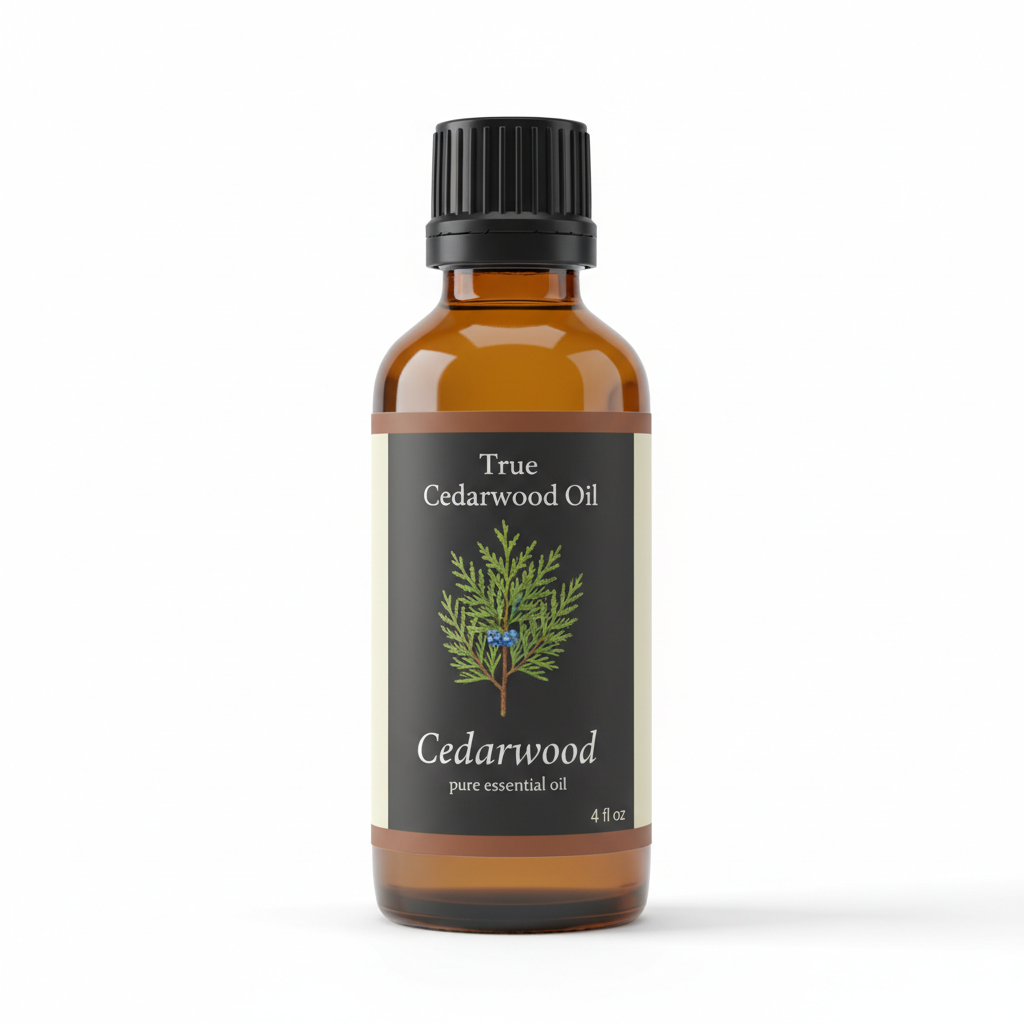
Cedarwood Essential Oil
Our own Cedarwood Essential Oil, in sizes from 0.5 oz to bulk.
From $9.99
Shop Now →What a label is required to say
US cosmetic rules work in a way many buyers do not expect. The FDA says cosmetic products and ingredients do not need premarket approval, and that a cosmetic is misbranded if its labeling is false or misleading. Nobody checks the species on a bottle before it is sold. On an ingredient list, the FDA explains, fragrance and flavor formulas may appear simply as "Fragrance," because the labeling law cannot be used to force a company to reveal trade secrets, and those formulas are complex mixtures of natural and synthetic ingredients.
So a product that says only "fragrance" tells you nothing about whether any cedar is in it. Even "cedarwood oil" does not tell you which tree: the Tisserand Institute notes that there are "at least five different Cedarwood oils."
Five wordings and what they tell you
| The label says | You learn | You do not learn |
|---|---|---|
| "Fragrance" or "parfum" | A formula of undisclosed ingredients | Whether any cedar is in it |
| "Cedarwood fragrance oil" | A scent product sold under a cedar name | What is in it |
| "Cedarwood oil", no botanical name | Probably an essential oil from a cedar-named tree | Whether it is a Cedrus or a Juniperus |
| A botanical name, such as Juniperus virginiana | Which tree the seller names | That nothing else is in the bottle |
| Botanical name plus a batch report | A document you can compare with the literature | Anything the report does not measure |
We list the botanical name of each oil on its product page: Atlas is Cedrus atlantica, Himalayan is Cedrus deodara, and the Virginian and Texas oils are junipers, Juniperus virginiana and Juniperus mexicana. We publish a certificate of analysis for one batch of the Atlas oil, giving relative density and refractive index. If you need gas chromatography data or other documentation for a lot, ask us in writing through the contact page before ordering.
What a real essential oil report looks like
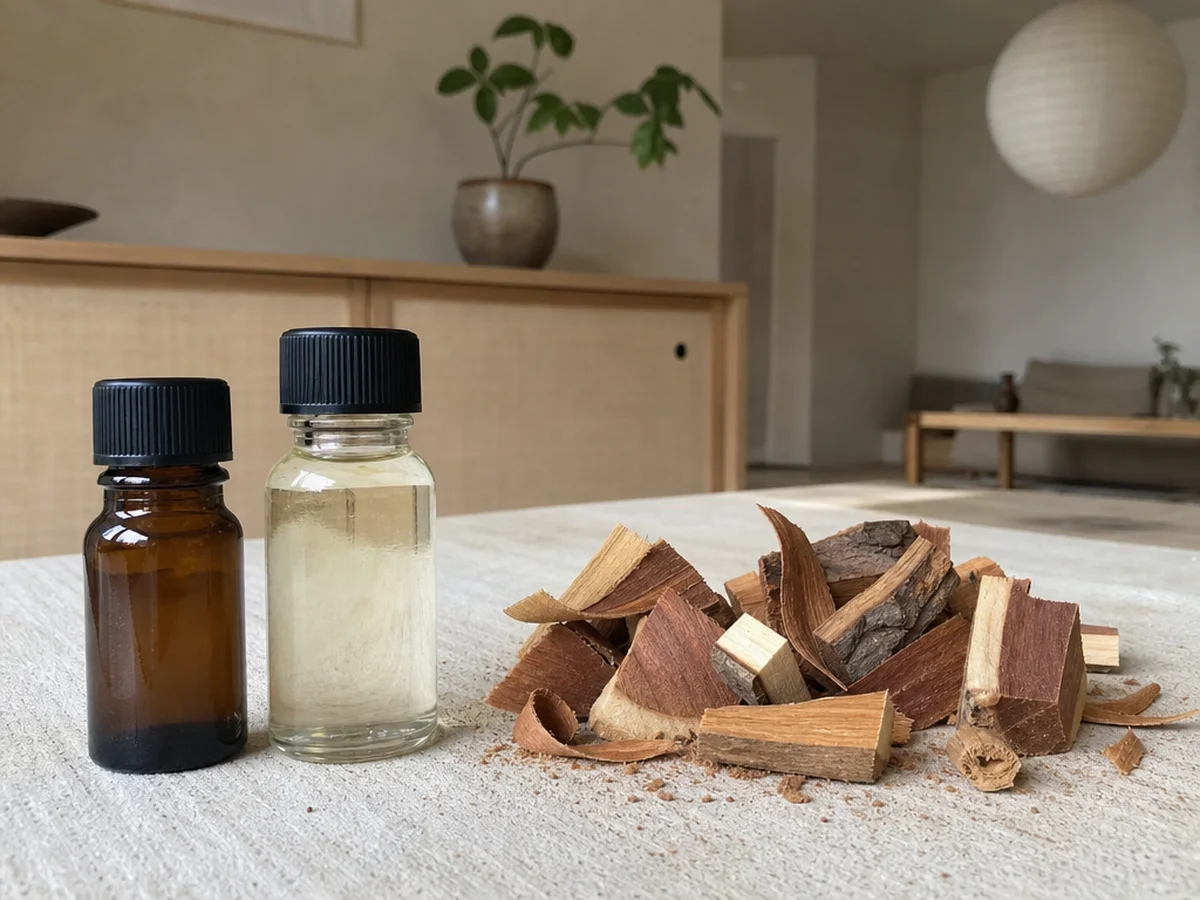
A report is only as useful as the thing you compare it with. A 2026 review analysed commercial wood oils from cedar-named trees. For 48 Atlas cedar oils the main compounds were beta-himachalene (about 40%), alpha-himachalene (about 15%) and gamma-himachalene (about 10%). For 56 Virginian oils the picture was different: alpha-cedrene (about 32%), cis-thujopsene (about 19%), cedrol (about 13%) and widdrol (about 11%). In plain terms, Cedrus oils are built on himachalenes, and the juniper cedarwoods on cedrenes, thujopsene and cedrol. A report showing something else, a single compound, or nothing at all is a cue to ask questions. For a walk through reading one, see our GC-MS article, and our adulteration article on why home tests cannot replace one.
Smelling the difference
If you ever have both on the bench, a side-by-side sniff is revealing. A distilled wood oil tends to smell like wood itself, a little uneven, dry at first and sweeter as it settles. A composed fragrance often smells very even and sharp from the first second, and may fade or change quickly. You will notice the essential oil asks more of your nose and rewards a second and third sniff. Neither is wrong, but they are different things, and knowing which you hold keeps your expectations honest.
Is one safer than the other?
Not automatically, in either direction. For cedarwood essential oils, a 2025 review says skin sensitization has been associated with the oil, particularly if oxidized or used inappropriately concentrated, and EFSA classed a Texas cedarwood oil as an irritant to skin and eyes and a skin and respiratory sensitizer. Our dilution guidance is 0.5% to 2% in a carrier, starting low and patch testing first; the review's 2% figure is a ceiling, not an endorsement. A fragrance oil comes with its own supplier's rate and documents, which are what you should follow if you choose one. "Natural" on the front of a bottle is not a safety statement either way.
Questions to ask any seller
A few plain questions go a long way with any bottle labelled cedarwood. What is the botanical name? Is it an essential oil or a fragrance blend? Can I see a document for the lot I am getting? You can ask us the same, in writing through the contact page, and we would suggest you do the same with anyone else. A good seller is glad to answer.
Choosing for the job
- Scent only, in a candle or soap, with no botanical claims on the label: either type can serve. Ask whichever supplier you pick for its recommended rate; the candle article and the soap article show our arithmetic for essential oil.
- A product that must name what is inside: an essential oil with a botanical name, plus a batch report for your lot.
- Perfumery: see the perfumery article for cedarwood as a base note and fixative.
- Anything left on skin: use sourced limits and professional advice.
We sell four cedarwood essential oils, two cedars and two junipers, described on our shop page. If you are choosing between them, the buying guide is the place to start. Knowing which tree is in the bottle is the single most useful thing a label can tell you.
Whichever bottle you end up with, a little curiosity about the label is time well spent, and the habit carries over to every scented product you pick up.
Cedarwood Essential Oil
Cedarwood Essential Oil from our own shop, in sizes from 0.5 oz to bulk.
From $9.99
Shop Now →Sources & Further Reading
- FDA Authority Over Cosmetics: How Cosmetics Are Not FDA-Approved, but Are FDA-Regulated, FDA
- Fragrances in Cosmetics, FDA
- What’s in a name?, Tisserand Institute
- Cedarwood Oils: The Wood Essential Oil Compositions from Trees Known as "Cedar"., Plants (Basel), 2026
- Cedarwood essential oil (Cedrus spp.): a forgotten pharmacological resource with emerging therapeutic potential, Exploration of Drug Science, 2025
- Safety and efficacy of a feed additive consisting of an essential oil obtained from the wood of Juniperus deppeana Steud. (cedarwood Texas oil) for use in all animal species (FEFANA asbl), EFSA Journal, 2024