Cedarwood Oil and ADHD: Where the Claim Began
If you have searched for cedarwood oil, you have probably met the claim: a blend of cedarwood, vetiver and lavender, breathed in by children with ADHD, and attention improves. It is repeated on dozens of pages, always with the same confident tone. We wanted to know where it starts, because a claim this widely shared ought to have a paper behind it.

Cedarwood Essential Oil
Our own Cedarwood Essential Oil, in sizes from 0.5 oz to bulk.
From $9.99
Shop Now →A story that gets smaller the closer you look
Almost every retelling points to one small pilot study, usually credited to a researcher named Friedmann and dated 2001. The pages that mention it do not link a journal record, and they do not agree with one another about how many children took part or how large the improvement was. When a number changes from page to page, it has usually been copied from copies rather than read from a paper. We could not locate the original, so we do not repeat any of its figures.
We also searched Europe PMC, the open index of the biomedical literature, on 5 November 2026 for cedarwood or cedar together with ADHD or attention deficit, and for aromatherapy or essential oils with ADHD among trials and reviews. Scanning the titles, we found nothing that tested inhaled cedarwood oil, or any essential oil, as an approach to ADHD. The nearest hits were an animal-study review of herbal medicine and a supplement trial using a lemon verbena extract. A search can miss papers, so the careful way to put it is that we did not find a study, which is different from proving none exists.
What the one cedarwood trial in people measured
There is a well-known human trial that included cedarwood in a blend, and it is useful mainly as a reality check. In 2003, researchers gave 313 people having radiotherapy either a carrier oil alone, a carrier with fractionated oils, or the essential oils of lavender, bergamot and cedarwood to inhale. Anxiety scores at the end were actually lower in the carrier-only group than in either fragrant group, and the authors concluded that aromatherapy as administered was not beneficial. It was adults, a different question and one blend, so it says nothing direct about children's attention. What it does show is how easily an appealing idea about scent fails to appear once a comparison group is added.
Why a small pilot cannot settle it
Children's attention changes from day to day. Parents and teachers who know a child is being treated rate behavior differently, and some children improve with time alone. That is why small pilots without a comparison group are good at asking whether a study is feasible and poor at showing that something works. A blend adds a second puzzle: if one of three oils were responsible, a blend study could not say which. And "cedarwood" itself covers more than one tree. We sell four cedarwood oils, two true cedars (Atlas and Himalayan) and two junipers (Virginian and Texas), and their chemistry differs.
What families are advised to do
The CDC's page on ADHD treatment says that for children under 6 the American Academy of Pediatrics recommends parent training in behavior management as the first line of treatment, and that for children 6 and older it recommends medication and behavior therapy together. It reports that between 70 and 80 percent of children taking stimulant medication have fewer ADHD symptoms. Essential oils do not appear in that guidance. A pediatrician, child psychiatrist or licensed psychologist is the right person for questions about attention, evaluation or medication, and a prescribed plan should only change on that clinician's advice.
How to read a claim like this online
A few habits make any health claim easier to size up. Look for a link to the actual journal record. Check who took part and whether there was a comparison group. Check the date, and whether other researchers repeated it. If any of those are missing, treat the claim as a story and not a finding. A good test is whether you can find the paper in two minutes. If you cannot, the page you are reading probably could not either.
When a claim concerns a child, take it to the child's doctor before changing anything. A pediatrician has seen plenty of well-meant tips that did not hold up, and can tell you which questions are worth asking.
Enjoying cedar the simple way
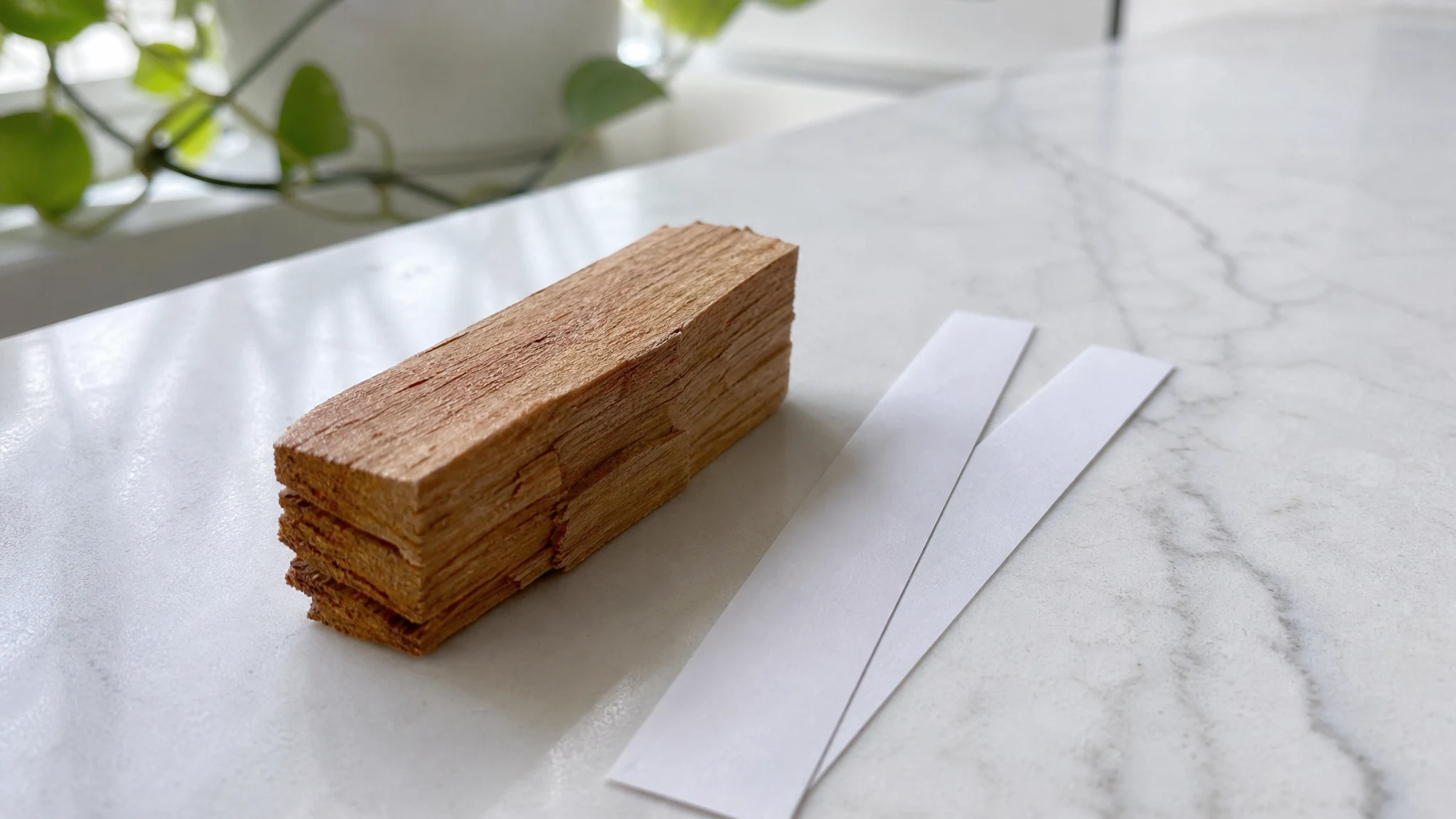
If you like the smell of cedar, there is plenty to enjoy about it without asking it to do a job. Open a bottle and smell it on a cotton pad. You will notice a dry, woody warmth that makes you think of a cabin or a closet drawer. A sachet in a wardrobe or a pad tucked in a drawer is all it takes.
Where our oils fit
We sell cedarwood essential oils as aromatic materials for external use, and we do not offer them for attention, focus or any condition. The scent itself is a different conversation: the Atlas oil is described on our shop pages as dry, woody and warmly sweet, and many people simply enjoy a woody room. Keep the bottle where children cannot reach it, as poison centers advise, and see our guide to cedarwood oil around children for storage and what to do after an accidental exposure. If you are curious how sleep and calm claims hold up, the anxiety article reads the same kind of evidence.
A good scent deserves honest credit for what it does, which is smell wonderful, and a good claim deserves a paper you can open.
Cedarwood Essential Oil
Cedarwood Essential Oil from our own shop, in sizes from 0.5 oz to bulk.
From $9.99
Shop Now →