Where to Buy Cedarwood Oil: What the Label Should Say
Picture two bottles on a shelf, both labelled "cedarwood oil." One might be a Himalayan cedar, the other a Virginia juniper, and nothing on the front tells you which. That is the whole challenge of buying cedarwood: the name is a trade term, and the answer to "what am I getting?" lives in the fine print. Here is what we look for, and what we would hope you ask us.

Cedarwood Essential Oil
Our own Cedarwood Essential Oil, in sizes from 0.5 oz to bulk.
From $9.99
Shop Now →Why the Latin name matters
The Tisserand Institute notes that common names are ambiguous and botanical names clear things up, adding that there are at least five different cedarwood oils (What’s in a name?). A 2026 review of wood oils from trees called "cedar" shows why it matters: true cedar oils (Cedrus) are generally led by compounds called himachalenes and atlantones, while Virginia and Texas-type juniper oils are led by cedrenes, cedrol and thujopsene (Cedarwood Oils: The Wood Essential Oil Compositions from Trees Known as "Cedar"). In its commercial samples, Atlas oil averaged about 40% beta-himachalene while Virginia oil averaged about 32% alpha-cedrene. Different molecules, different scent, different recipes.
We sell four cedarwood oils and name every one: Atlas (Cedrus atlantica) and Himalayan (Cedrus deodara), the two true cedars, and Virginian (Juniperus virginiana) and Texas, which we list as Juniperus mexicana, the two junipers. Even the Texas tree has more than one name in the literature. EFSA's 2024 opinion on cedarwood Texas oil names it as Juniperus deppeana (Safety and efficacy of a feed additive consisting of an essential oil obtained from the wood of Juniperus deppeana Steud. (cedarwood Texas oil) for use in all animal species (FEFANA asbl)). That is a good reason to ask any seller for a report rather than trust a common name. Those percentages are averages across commercial oils, not results for our bottles.
What a label does and does not guarantee
Many shoppers assume somebody has approved what is on the bottle. FDA's page on cosmetics explains that cosmetic products and ingredients do not need FDA premarket approval, that retail cosmetics need an ingredient list, and that a label is misbranded if it is false or misleading (FDA Authority Over Cosmetics: How Cosmetics Are Not FDA-Approved, but Are FDA-Regulated). So a Latin name on a bottle is the seller's choice, which makes its presence informative. Words like "tested" or "purity" are claims, and they become useful only when a document for your lot stands behind them.
Five questions worth asking before you pay
- What is the botanical name, and is it on the bottle? A label that says only "cedarwood oil" cannot tell you whether you are getting a cedar or a juniper. Both are fine products. The point is knowing which one.
- Which oil does your project call for? The four are not interchangeable in a recipe. The Virginian is dry and pencil-shaving sharp, the Himalayan softer and resinous, the Atlas dry and warmly sweet, and the Texas soft and in between. Pick for the scent you want, not the lowest price.
- Is there a lot number, and a document for that lot? A certificate only helps when its batch number matches your bottle.
- What does the document measure? Density and refractive index are physical checks. A GC-MS report lists what is actually in the oil, and our GC-MS article shows how to read one.
- What dilution does the seller suggest? Ours is 0.5% to 2% in a carrier oil with a patch test first, and we lean to the low end. A 13-week rodent study of Virginia cedarwood oil on skin worked out benchmark dose lower limits of 0.65% to 4.4%, depending on the sex of the animal (Dose-response assessment of the dermal toxicity of Virginia cedarwood oil in F344/N rats and B6C3F1/N mice). That is animal data, but it is why we would not call anyone's number a verified safe maximum, ours included.
An unhurried way to shop
Shopping for a base-note oil should not feel like an exam. Write your questions down before you open any listing, and keep a short list of what you need: the species, the plant part, the document, and the suggested dilution. If a seller replies clearly and quickly, that tells you something. If you need a lot of back-and-forth to get a straight answer, that tells you something too. Keep the replies together in one folder so you can look back when your bottle arrives and compare what you were told with what you are holding.
Start small, then repeat what you like
Whichever seller you choose, a small first bottle is a sensible way to find out whether the scent suits your project. Smell it on a strip, note your impressions, and only then plan the larger batch. It is the habit we recommend for any oil.
What we can tell you about our oils
The Certificate of Analysis we publish covers one batch of our Atlas oil. It lists a relative density of 0.934 and a refractive index of 1.513, each inside its printed range. It does not include GC-MS data. For our Himalayan, Virginian and Texas oils, we invite you to ask about documentation before ordering. If you need species confirmation, a constituent report or an origin for a specific lot, write to us through the contact page and get the answer in writing before you rely on it. The same habit serves you well with any supplier. Our wholesale page also offers sample bottles for larger buyers.
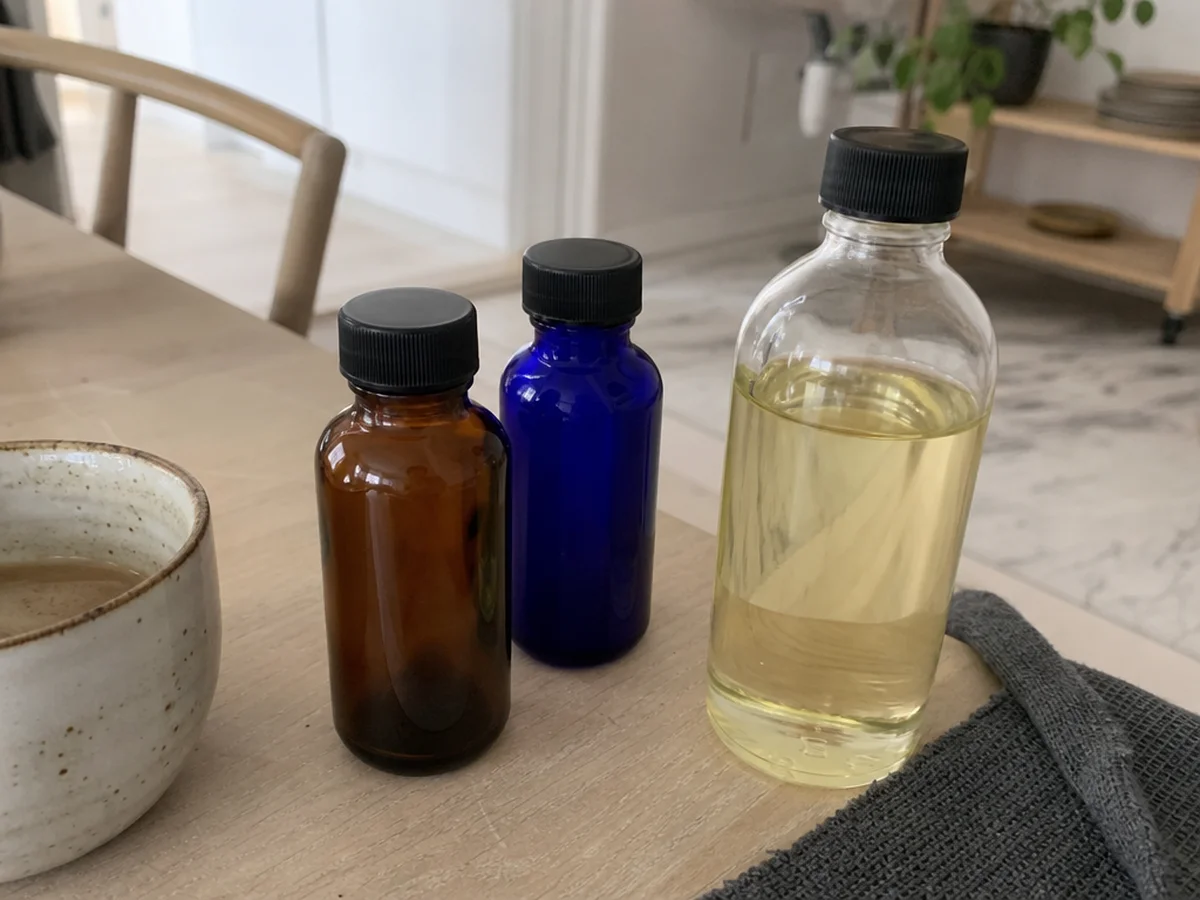
We keep to cedarwood oil. Carrier oils are easy to find at grocery stores and pharmacies, droppers and bottles at craft or soap-supply shops, and cedar blocks and hangers at hardware or closet stores. For pregnancy, medical conditions, children or pets, check with a physician, pharmacist or veterinarian first. Our safety article and adulteration article go further, and the brand listings comparison shows these questions applied to other sellers.
A good seller answers all five questions easily, and the best ones are glad you asked.
Cedarwood Essential Oil
Cedarwood Essential Oil from our own shop, in sizes from 0.5 oz to bulk.
From $9.99
Shop Now →Sources & Further Reading
- Tisserand Institute. What’s in a name? tisserandinstitute.org
- Setzer and Satyal, 2026. Cedarwood Oils: The Wood Essential Oil Compositions from Trees Known as "Cedar". Plants (Basel). Europe PMC 41754364
- EFSA FEEDAP Panel, 2024. Safety and efficacy of a feed additive consisting of an essential oil obtained from the wood of Juniperus deppeana Steud. (cedarwood Texas oil) for use in all animal species (FEFANA asbl). EFSA Journal. Europe PMC 38756350
- FDA. FDA Authority Over Cosmetics: How Cosmetics Are Not FDA-Approved, but Are FDA-Regulated. fda.gov
- Catlin et al., 2016. Dose-response assessment of the dermal toxicity of Virginia cedarwood oil in F344/N rats and B6C3F1/N mice. Food and Chemical Toxicology. Europe PMC 27769849