Cedarwood Oil and Anxiety: What the Studies Really Show
Walk into a spa and the cedar is probably part of the picture: warm, dry, a little sweet, the smell of a quiet wooden room. It is easy to assume that scent must also settle the nerves. When researchers have actually looked, though, the story is quieter and more interesting than a simple yes or no, and it is worth knowing what has and has not been studied.
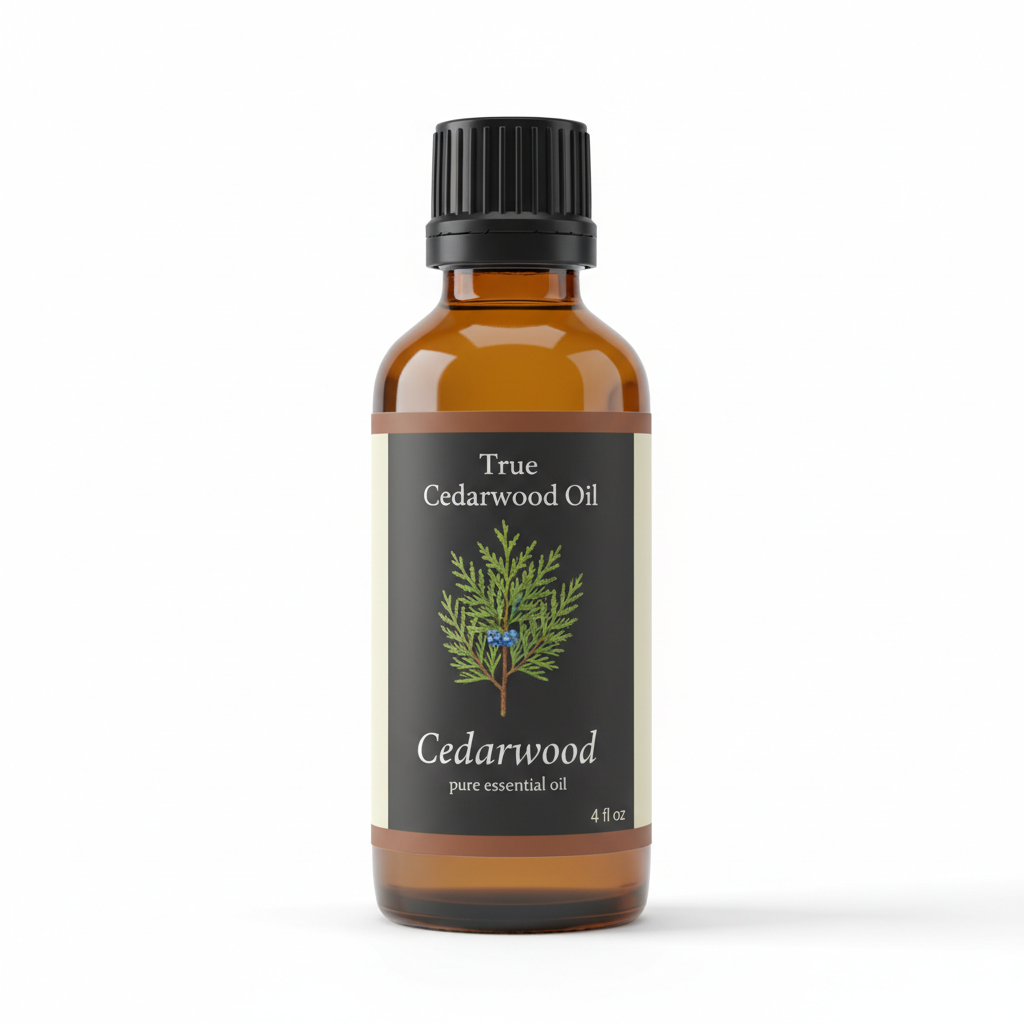
Cedarwood Essential Oil
Our own Cedarwood Essential Oil, in sizes from 0.5 oz to bulk.
From $9.99
Shop Now →A trial in which cedarwood was one of three oils
The best-known human trial that included cedarwood took place at an Australian cancer centre. Graham and colleagues randomly assigned 313 people having radiotherapy to breathe one of three things during treatment: a carrier oil with fractionated oils, a carrier oil alone, or a blend of lavender, bergamot and cedarwood essential oils. Depression and psychological scores did not differ between groups, and at the end of treatment the carrier-only group actually reported slightly lower anxiety scores than either of the scented groups. The authors concluded that aromatherapy as given in that study was not beneficial.
It would be a mistake to over-read that result in either direction. It was a three-oil blend, so nothing can be pinned on cedarwood alone, and the people involved were patients in a stressful clinical setting rather than someone unwinding at home. What it does tell us is that a pleasant-smelling blend containing cedarwood did not beat plain carrier oil in a properly randomised trial, which is a useful corrective for anyone who assumes a lovely scent automatically does something measurable.
The mouse study that cuts both ways
The other paper people point to is a 2018 study by Zhang and Yao on eastern red cedar oil (Juniperus virginiana) in mice. Their oil contained roughly 28 percent alpha-cedrene, 18 percent thujopsene and 25 percent cedrol. Given by injection into the abdomen at 400 to 800 mg per kg, the oil increased the time mice spent in the open arms of an elevated maze, a standard rodent measure, but it showed no effect in a second test, the light-dark box.
The most fascinating finding is hidden in the details. When the researchers tested the components separately, cedrol showed an effect in both tests, while the cedrenes did the opposite, producing anxiety-related behaviour and less movement. In other words, the "cedarwood" in a bottle is a mixture whose parts may pull in different directions, which is a good reason to be cautious about any broad claim for the whole oil. Injection is also nothing like breathing the scent of a room, so this is a lab finding in mice, not something we can carry over to people.
Why the species on the label matters
That mouse study used a juniper oil, and cedrol is a signature compound of the junipers. Our Virginian and Texas oils are junipers, while our Atlas and Himalayan oils are true cedars (Cedrus), whose chemistry is dominated by other compounds, mostly himachalenes. So even if you set aside the difference between a mouse and a person, a result for one cedarwood does not automatically describe another. If you are curious about that chemistry, our article on cedrol and atlantones walks through which compounds belong to which oil.
Why the spa association is so strong
Scent and place get tangled together in memory. If the first time you met cedar was a sauna bench, a wooden hallway or a favourite blanket chest, the smell carries that whole setting with it. Part of what makes cedarwood feel special is simply that it reminds many people of somewhere they liked being. That is a personal, pleasant association, and it is a different thing from a measured effect.
It is a good habit to notice it in yourself. Open a bottle and ask what the smell brings to mind: a closet, a pencil case, a campfire, a library. Your answer says more about you than about the oil, and it is a lovely way to choose among Atlas, Himalayan, Virginian and Texas, which each paint a slightly different picture.
Enjoying the aroma for what it is
We sell cedarwood oils as aromatic materials for external use. We do not offer them as an answer to anxiety, and we would rather tell you plainly what the studies show than imply more. Scent is wonderfully personal, and if you simply love the smell of cedar in a room or in a diluted body or hair oil, that is reason enough to enjoy it. If you do use an oil on skin, our guidance is to dilute to 0.5 to 2 percent in a carrier, patch test first, and keep it away from eyes, children and pets. For ideas on enjoying the aroma without a claim attached, take a look at our diffuser basics and our notes on cedarwood in a quiet routine, and for the bigger picture on claims see our look at cedarwood benefits and the evidence.
Feeling anxious is common, and the NHS points people to their GP when worry is hard to control or affects daily life, with talking therapies as a first option. If that sounds familiar, a doctor or a licensed mental health professional is the right person to talk to, long before any fragrance enters the conversation. Cedar in the room is simply one of the small pleasures that can sit alongside good care.
Cedarwood Essential Oil
Cedarwood Essential Oil from our own shop, in sizes from 0.5 oz to bulk.
From $9.99
Shop Now →Sources & Further Reading
- Graham PH, Browne L, Cox H, Graham J, 2003. "Inhalation aromatherapy during radiotherapy: results of a placebo-controlled double-blind randomized trial." Journal of Clinical Oncology. PubMed 12805340
- Zhang K, Yao L, 2018. "The anxiolytic effect of Juniperus virginiana L. essential oil and determination of its active constituents." Physiology & Behavior. PubMed 29326032
- NHS, "Generalised anxiety disorder (GAD) - NHS." nhs.uk