Cedarwood Oil Around Dogs: Spills, Licks and Storage
Dogs share our sofas, our kitchens and, sooner or later, whatever we leave on a low shelf. That is the real question behind most searches about cedarwood oil and dogs: not whether a dog likes the smell, but what happens in the ordinary moments when oil and dog meet. We make our oils for people and for external use, and a veterinarian is the right person for any decision about a dog.
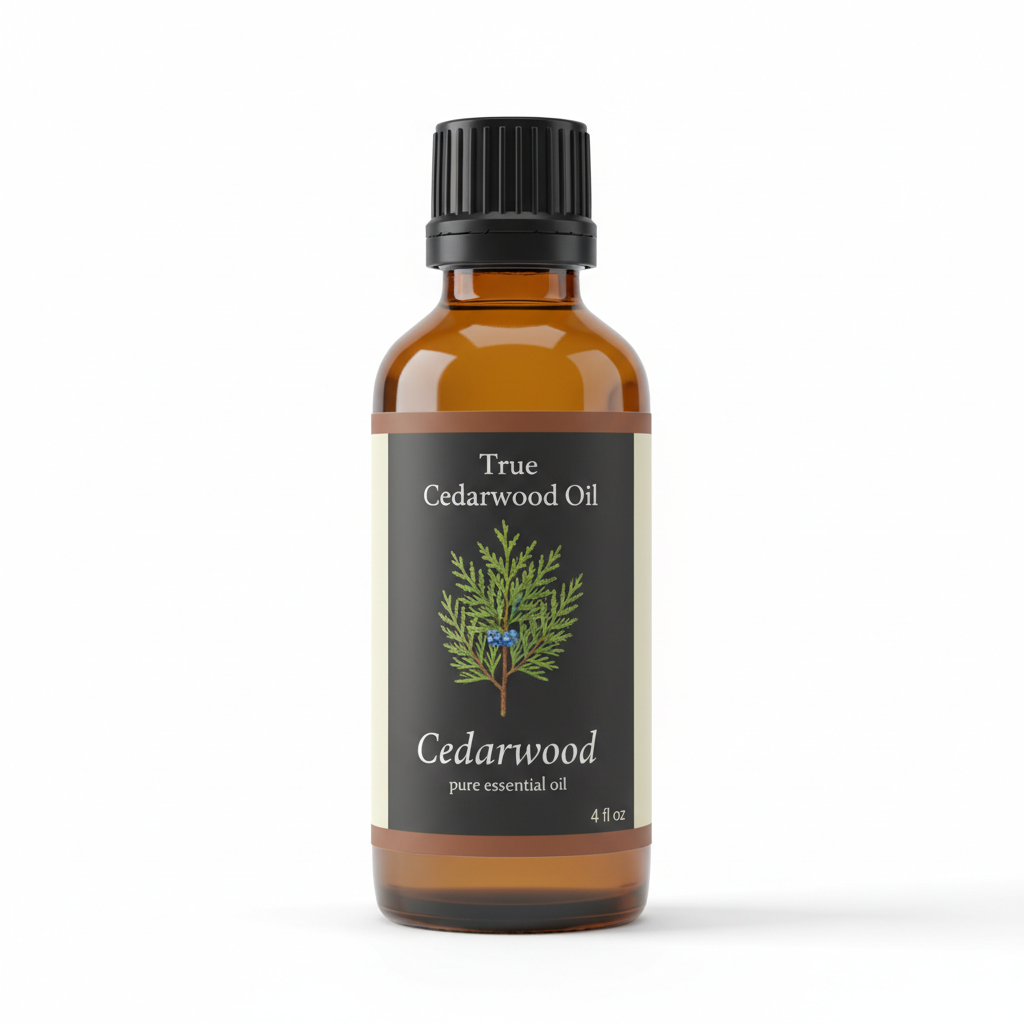
Cedarwood Essential Oil
Our own Cedarwood Essential Oil, in sizes from 0.5 oz to bulk.
From $9.99
Shop Now →The picture from poison specialists
The Pet Poison Helpline lists cedar among the essential oils that can cause poisoning in pets. For dogs the common signs it describes are drooling, vomiting, lethargy and a poor appetite, with irritation of the skin, mouth and airways also possible, and it stresses that stronger, more concentrated exposures matter most. It ranks swallowing as the highest-concern route, skin contact next and breathing vapour last (Essential Oils | Pet Poison Helpline). Cats are named as the more sensitive species, and our cat guide covers that side. Dogs are not exempt, though, and three everyday situations show why.
Oil on the coat
A common idea is to add a few drops of an essential oil to a shampoo or spray. The nearest published evidence comes from plant-oil flea products, which are exempt from EPA registration. In a review of poison-centre calls from 2006 to 2008, 8 of 9 dogs exposed to such products had an adverse effect, most often lethargy and vomiting, and a majority of the animals had been exposed as the label directed (Adverse reactions from essential oil-containing natural flea products exempted from Environmental Protection Agency regulations in dogs and cats). Nine dogs is a small group and the products were mixtures, so we read the paper as a pattern rather than a rate.
The skin evidence for cedarwood itself comes from rodents. Virginia cedarwood oil in ethanol was applied to rats and mice for 13 weeks at 6.25% to 100%, and the benchmark dose limits for skin changes fell between about 0.65% and 4.4%, which the authors said overlaps with concentrations used in cosmetic and pesticide products (Dose-response assessment of the dermal toxicity of Virginia cedarwood oil in F344/N rats and B6C3F1/N mice). A dog is neither a rat nor a person, so this is no dog result. It does suggest that the 0.5% to 2% range we give for human skin should not be borrowed for a dog.
Oil that gets licked
Dogs investigate with their mouths. A knocked-over bottle, a diffuser reservoir within reach or oil on a person's skin or bedding can all end up on a tongue, and that is the route the helpline ranks highest. The helpline says not to induce vomiting, because oil breathed into the lungs is a hazard of its own, and mentions early dilution with water or food as a step vets may advise. Treat that as information to pass to a professional rather than a to-do list: call a veterinarian or the Pet Poison Helpline medical line at (855) 764-7661 with the bottle in hand, since signs can take hours to appear.
For scale, a European Food Safety Authority panel assessing a Texas cedarwood oil as an animal feed flavouring set a maximum safe level of 15 mg/kg of complete feed for dogs, against 4 mg/kg for cats, and classed the oil as a skin and eye irritant and a skin and respiratory sensitiser (Safety and efficacy of a feed additive consisting of an essential oil obtained from the wood of Juniperus deppeana Steud. (cedarwood Texas oil) for use in all animal species (FEFANA asbl)). It is a food-level allowance for one oil, so it says nothing about a spill, but it shows that a dog's tolerance of a trace in food is not a licence to leave neat oil within reach.
Oil in the air
Breathing vapour is the lowest-ranked route, which is reassuring without being a guarantee. A dog that can wander out of the room is in a very different position from one shut in with a running diffuser, and a small dog or one with heart or breathing conditions deserves a conversation with the vet first. We cover the room-side basics in our diffuser article.

Walk the house at dog height
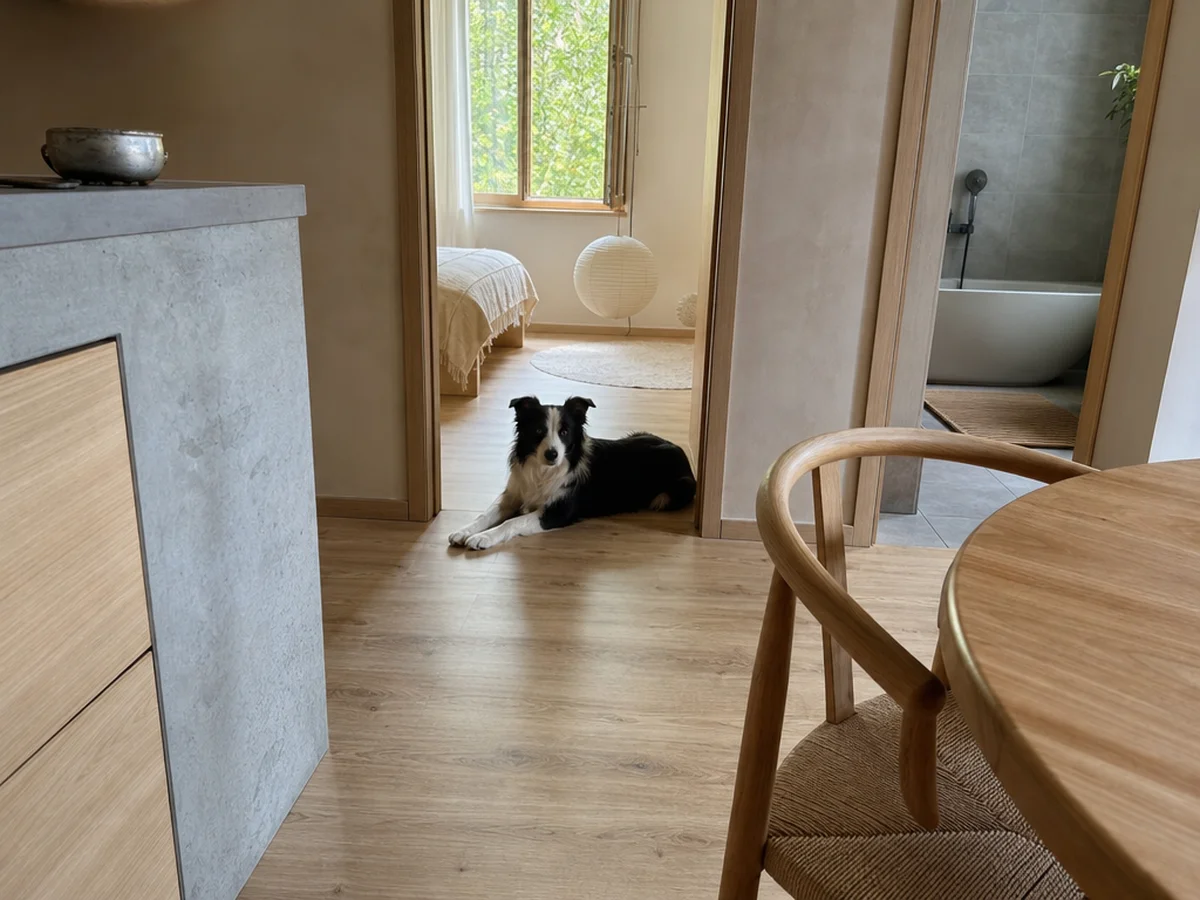
Before you decide where a bottle lives, get down on your knees and look at the room the way a dog does. Low shelves, the edge of a bedside table, an open tote bag on the floor and a bathroom counter a dog can reach from the toilet lid all count. The same goes for the places a bottle goes when you are busy: next to the sofa while you make a sachet, or on the arm of a chair beside a cup of tea.
It also helps to remember how much more a dog's nose picks up than yours. When you open a bottle of cedarwood, whatever you smell, your dog is getting a much bigger version of it. Open it in a room the dog is not in, close it firmly, and let the room air out a little before the dog wanders back in.
Habits that keep it simple
- Store the bottle capped, high and closed in a cupboard. Our guidance for all four oils is to keep them away from children and pets, and our note on children shares the same storage logic.
- Wash your hands after handling neat oil before petting or feeding your dog.
- Keep oil off the dog, diluted or not, and ask a veterinarian about any grooming or flea product.
- Ring the vet early if a dog has licked or been splashed. A quick call costs far less than waiting.
Plenty of households enjoy cedar scent and keep a dog happily. It comes down to where the bottle lives and who can reach the room. Our general safety overview covers people, children and pregnancy.
Cedarwood Essential Oil
Cedarwood Essential Oil from our own shop, in sizes from 0.5 oz to bulk.
From $9.99
Shop Now →Sources & Further Reading
- Essential Oils | Pet Poison Helpline
- Adverse reactions from essential oil-containing natural flea products exempted from Environmental Protection Agency regulations in dogs and cats (Genovese et al., J Vet Emerg Crit Care, 2012)
- Dose-response assessment of the dermal toxicity of Virginia cedarwood oil in F344/N rats and B6C3F1/N mice (Catlin et al., Food Chem Toxicol, 2016)
- Safety and efficacy of a feed additive consisting of an essential oil obtained from the wood of Juniperus deppeana Steud. (cedarwood Texas oil) for use in all animal species (FEFANA asbl) (EFSA Panel on Additives and Products or Substances used in Animal Feed, EFSA J, 2024)